

Cutting straight lines shouldn’t feel like a struggle—and with the right track saw, it never has to be. Whether you’re working on cabinets, flooring, or plywood sheets, a good track saw gives you clean, accurate cuts without the bulk of a table saw. In this guide, we’ll help you find the best track saws that offer power, precision, and portability. We’ve tested and compared the top picks so you can choose the right one for your project, skill level, and budget. Let’s break it all down and make your next cut smoother, faster, and easier.
Top 5 Track Saws:
1. Festool 577014 Plunge-Cut Track Saw

This saw doesn’t just cut — it glides like a scalpel through hardwood, plywood, and MDF, delivering pro-level precision without the pro-level frustration or setup hassle.
I’ve used the Festool 577014 Plunge-Cut Track Saw for everything from cabinet installs to finish trim, and it’s easily one of the best tools I’ve ever owned. What stands out right away is how fast and clean it cuts. Festool claims it’s twice as fast as earlier models, and I believe it. The motor powers through dense material without hesitation, and the new blades stay sharp even after heavy use.
What really impressed me is the splinter-free finish on both sides of the cut — a game changer when working with expensive plywood. The attachable splinter guard works flawlessly, even on bevels up to 47°. And speaking of bevels, the cutline stays perfectly aligned whether you’re cutting straight at 90° or tilted for that perfect undercut.
The 55″ guide rail is dead accurate, and the riving knife makes plunge cuts safer and smoother. I also appreciated the dust extraction system — it pulls out most of the dust, keeping my work area clean and my lungs happier.
Yes, it’s heavier than most at just under 23 pounds, but that weight adds stability and helps keep cuts steady. This isn’t a budget tool — it’s built for serious work. If you care about precision, durability, and saving time on the job, this saw is absolutely worth it.
2. Makita SP6000J1

This saw turns jobsite chaos into clean, controlled perfection — fast, splinter-free cuts without dragging your table saw across the garage or workshop.
After weeks of putting the Makita SP6000J1 Plunge Cut Circular Saw to work, I’m seriously impressed. This thing is smooth, powerful, and surprisingly precise. The 12-AMP motor doesn’t flinch, even when ripping hardwood. I used it on cabinet panels, stair treads, and trim boards — every cut came out clean with zero tear-out.
The included 55″ guide rail is a game-changer. It locks the saw in place, giving you buttery-straight cuts that feel more like a panel saw than a handheld tool. Pair that with the variable speed control (2,000–5,200 RPM), and you can match the power to the material — I had no trouble moving from MDF to plywood to solid oak without slowing down.
Makita nailed the bevel range, too. With settings from 1° to 48° and solid stops at 22.5° and 45°, I didn’t have to second-guess my angles. And it cuts close to the wall — a big bonus when you’re working tight. The plunge release and depth controls are easy to use, and the soft start keeps it from jumping out of your hands.
It’s lighter than you’d expect, yet stable on the track. Whether you’re in the shop or on-site, this saw brings serious table saw precision in a portable package. For remodelers, woodworkers, or trim pros, this tool seriously earns its keep.
3. DEWALT DCS520B 60V MAX* Circular Saw

You can feel the power in your hands—this DEWALT cordless TrackSaw slices through hardwood like it’s cutting butter.
After weeks of heavy shop use, this saw became my go-to for clean, precise cuts without the hassle of cords. The DEWALT DCS520B doesn’t just impress—it dominates. Its zero-clearance cutting system, paired with the dual-edged track, gives me splinter-free, glass-smooth edges every time. Whether I’m trimming plywood or doing plunge cuts in oak, this thing eats through it with ease.
What really elevates the experience is the anti-kickback mechanism and the riveting knife. It locks in with confidence, especially during deeper cuts, and keeps your hands safe without any drama. The plunge mechanism feels ergonomic and deliberate—no wobble or resistance. The build is solid, and the brushless motor? Strong and quiet, even at max speed.
The depth of cut is 2-1/8″ at 90 degrees, which has handled everything I’ve thrown at it so far. Add to that a bevel range of up to 47 degrees, and you’re working with serious flexibility. The 90% dust extraction feature is also no joke—I paired it with my shop vac and barely needed cleanup after.
Downsides? It’s a bare tool, so you’ll need to bring your own 60V battery. But if you’re already in DEWALT’s FlexVolt ecosystem, this saw fits right in. In my book, this TrackSaw doesn’t just replace the table saw—it outperforms it for most tasks.
4. Evolution Power Tools R185CCSX
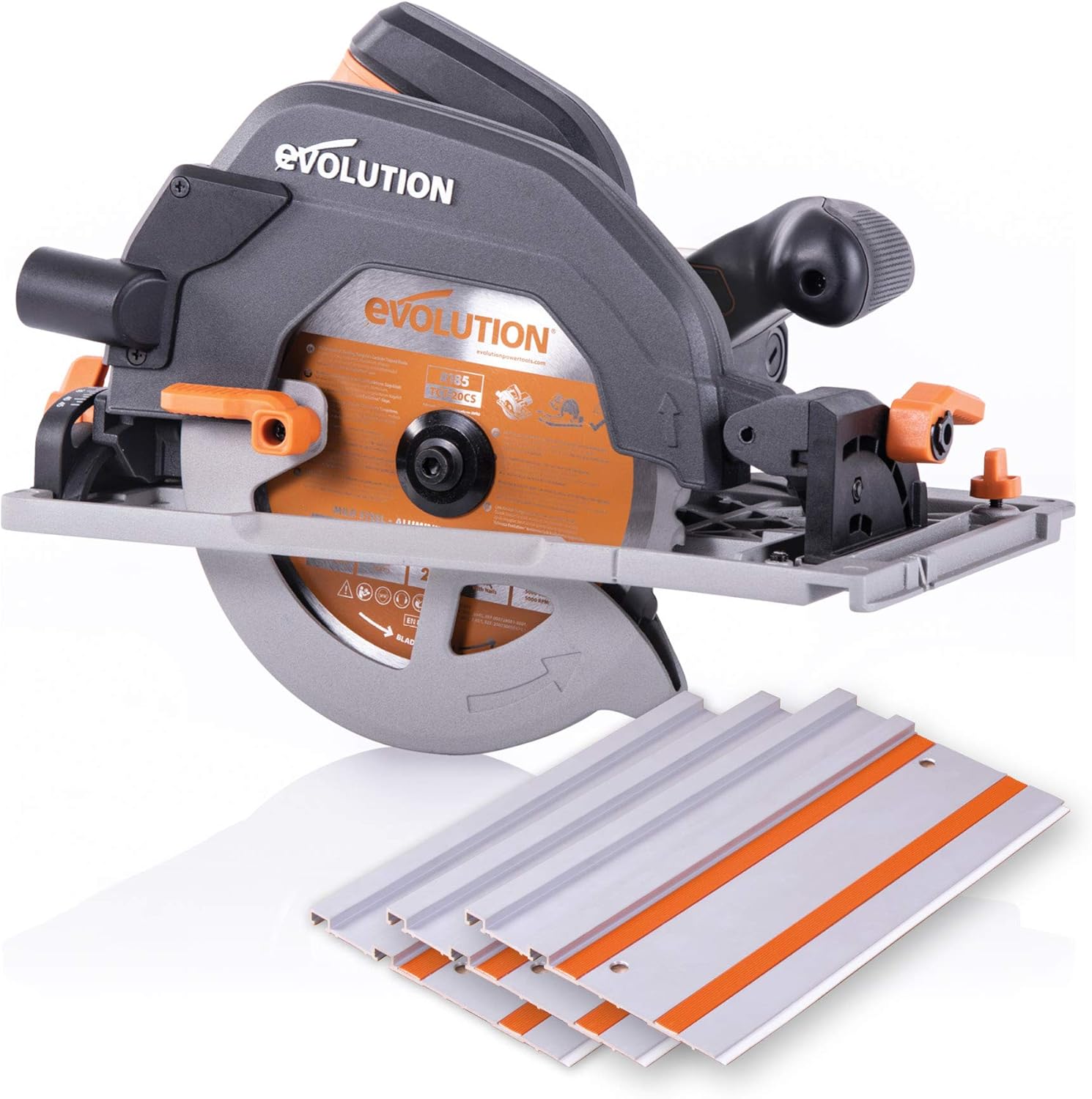
Cutting wood, plastic, and even metal—all with one blade? This saw doesn’t just talk the talk, it walks the cut.
Right out of the box, the R185CCSX from Evolution impressed me. You’re getting a 7-1/4″ saw that comes bundled with a 40″ track and everything you need to get rolling—including a quality TCT blade. I was skeptical about its multi-material claims, so I ran it through hardwood, PVC, and even thin aluminum trim. It powered through all three without blade changes, and that alone makes it a timesaver.
Its 15-amp high-torque motor is the real hero here. It stays cool even during prolonged cuts and maintains speed without bogging down. I especially like the adjustable depth—cutting up to 2 1/2 inches deep lets you handle thick materials easily. Plunge cuts are straightforward and precise. The bevel adjustment (0-45°) works smoothly with clear detents, and the track keeps things locked down with no slippage.
The ergonomic soft grip makes a difference if you’re doing multiple cuts in a session, and the dust extraction port works surprisingly well—hook it to a shop vac and it keeps your line of sight clean. The channeled airflow also helps push debris aside while cutting, which is a subtle but effective touch.
It’s not as refined as a Festool or Makita, but for the price, this thing delivers real value. It’s the perfect upgrade for DIYers stepping into serious work or pros looking for a reliable backup saw.
5. WEN CT1065 Circular Track Saw

Budget-friendly and packed with power, this WEN saw slices like a pro without burning through your wallet.
I’ll be honest: I didn’t expect much at this price point. But the WEN CT1065 pleasantly surprised me. It’s got a strong 10-amp motor that spins the 6-1/2″ blade up to 5,500 RPM, and that speed translates to seriously clean cuts. I ripped through 3/4″ birch ply and pine boards like nothing. The plunge mechanism is smooth, the base is stable, and the depth gauge lets you dial in to 2-1/3″ max.
It does bevel cuts too—up to 45°—and I used it for angled trim cuts that came out sharp and accurate. Switching between scoring and full plunge modes is quick and intuitive. And the blade swap process? Straightforward, with the safety locks making it hassle-free.
One thing I like is the flexibility: it works beautifully on the WEN 100″ track (sold separately), but the flat base means you can use it freehand too. Just set the cams to reduce kickback, and it stays steady. Dust collection is decent for a mid-range tool—I hooked it up to a small shop vac and it handled light to medium cleanup well.
It’s not built like a DEWALT or Makita, and the included blade could be sharper, but for furniture builds, plywood cuts, or trimming doors, it gets the job done. Plus, you’re backed by WEN’s two-year warranty and great customer support. For underdog performance with big-league results, this one deserves a spot in your workshop.
The Ultimate Buying Guide for The Best Track Saw
Introduction
If precision cutting is part of your woodworking life, a track saw can be a total game-changer. Whether you’re breaking down full sheets of plywood or making straight, splinter-free cuts in hardwood, this tool offers accuracy and efficiency that a traditional circular saw or even a table saw might struggle to match.
Track saws (sometimes called plunge saws) are designed to ride on a guide rail, giving you straight cuts every time—no clamps or jigs required. They’re portable, versatile, and powerful enough to handle both DIY and professional workloads.
What sets a track saw apart is its ability to deliver clean, accurate cuts with minimal setup, especially over long distances. It’s ideal for cabinetry, furniture building, remodeling, or any task that requires exact straight cuts without a bulky table saw. From hobbyists working in their garage to contractors on a job site, track saws can elevate your workflow by saving time and increasing accuracy.
This guide is here to help you find the best track saw for your needs. We’ll go over the different types, key features to look for, practical tips before buying, pros and cons, and some maintenance advice to ensure your investment lasts. Let’s dive into everything you need to know about buying the right track saw for your projects.
Types of Track Saws
While all track saws share the same goal—making accurate, straight cuts—they vary in design, features, and use cases. Here are the main types you’ll come across:
1. Corded Track Saws
Corded track saws are the most common type. They plug into a power outlet and deliver consistent, high-level performance without the worry of battery life. These are ideal for prolonged use and high-power tasks, especially in workshop settings.
Best For: Professionals or anyone working near a power source and requiring extended runtime.
2. Cordless Track Saws
Cordless models offer unmatched portability. Powered by rechargeable lithium-ion batteries, they’re great for job sites or cutting large sheets where power outlets are hard to reach. Modern battery tech has made them impressively powerful, though runtime can still be a limitation.
Best For: Contractors, remodelers, or anyone needing to move around a lot with minimal setup.
3. Compact/Mini Track Saws
These smaller saws are perfect for lighter jobs or where space is tight. They’re easier to control and less intimidating for beginners, though they usually can’t handle thick hardwoods or heavy-duty use.
Best For: DIYers or those working on small woodworking projects at home.
4. Track Saw Kits
Some brands sell complete kits that include the saw, rail, carrying case, and sometimes dust collection accessories. This is a convenient way to get everything in one go.
Best For: Beginners or anyone starting from scratch who wants to avoid compatibility headaches.
Key Features to Look For
1. Cutting Depth and Bevel Capacity
This determines how thick of a material you can cut and at what angles. A good track saw should offer at least 2 inches of cutting depth and the ability to bevel to 45° or more.
2. Motor Power
The power rating (usually in amps for corded or volts for cordless) directly affects how smoothly the saw can cut through dense material. Aim for 10–13 amps (corded) or 18–60V (cordless) depending on your workload.
3. Track Compatibility and Length
Check if the saw comes with its own track or is compatible with standard rails like those from Festool or Makita. Also, make sure the track length fits your typical project sizes (e.g., 55″ for plywood sheets).
4. Dust Collection
Efficient dust collection makes a big difference in both visibility and cleanup. A good track saw should have a dust port that connects to a vacuum or dust extractor.
Bonus Features
-
Plunge Action Control: Smooth plunging makes the saw safer and easier to handle.
-
Anti-Kickback Features: Adds safety, especially for beginners.
-
Track Clamps or Anti-Slip Strips: Keeps the rail firmly in place.
-
Riving Knife: Prevents binding and kickback during long cuts.
Things to Consider Before Buying
Budget
Track saws range from around $200 for entry-level models to $800+ for premium brands like Festool. A mid-range option ($300–$500) usually balances quality, performance, and value. Factor in the cost of tracks and accessories.
Size/Space
If you work in a compact workshop, consider a smaller track or a compact saw. For large sheet goods, you’ll want a longer rail (often around 55–75 inches) and adequate working space.
Ease of Use
Look for intuitive controls, a smooth plunging mechanism, and lightweight design if portability matters. Some models also offer tool-free blade changes and easy-to-read scales for depth and bevel adjustments.
Durability/Warranty
Reputable brands offer solid warranties—often 3 years or more. Check for magnesium or aluminum components, which are lighter and more durable. Read user reviews for insight into long-term reliability.
Pros and Cons
| Pros | Cons |
|---|---|
| Extremely precise cuts | Expensive compared to circular saws |
| Portable and space-saving | Requires track setup for each cut |
| Cleaner cuts with less tear-out | Tracks can be costly or proprietary |
| Easy to use, even for beginners | Not ideal for rip cuts on thick lumber |
| Great for sheet materials | Battery models may lack power for heavy-duty work |
Step-by-Step Buying Guide
1. Research Your Needs
Start by thinking about your primary use. Are you working mainly with plywood? Do you need bevel cuts? How often will you use the saw, and where? Your answers will help determine whether a corded, cordless, or compact model makes the most sense.
2. Compare Products
Once you know your needs, compare features like cutting depth, bevel angle, power, and accessories. Read customer reviews for real-world performance insights. Watch video demonstrations to see how each model handles in action.
3. Finalize Your Choice
After narrowing your options, check for things like warranty, support, and parts availability. Buy from trusted retailers or directly from the manufacturer. If buying online, make sure the return policy is friendly in case the saw doesn’t suit you.
Maintenance Tips
1. Clean the Track and Saw Base Regularly
Dust buildup can affect accuracy. Wipe the track and base with a soft cloth after each use to keep performance smooth.
2. Avoid Cutting Over Screws or Nails
This can damage the blade or track. Always inspect your material beforehand and mark out hazards.
3. Keep the Blade Sharp
A dull blade splinters the wood and forces the motor to work harder. Replace or sharpen it periodically, especially after tough cuts.
Common Issues and Troubleshooting
-
Track Slipping: Clean the anti-slip strips or consider using track clamps.
-
Burn Marks on Wood: Blade may be dull or moving too slowly through hardwood. Replace the blade or adjust speed.
-
Saw Not Cutting Straight: Ensure the track is clean and positioned properly, and check that the base is aligned with the rail.
Final Words
Choosing the right track saw can completely transform the way you cut wood. Whether you’re building furniture, installing flooring, or just want to make straighter cuts with less hassle, investing in a quality track saw is worth every penny. Focus on features that match your project needs—like power, cutting depth, and dust collection—and don’t be afraid to spend a little more for long-term value. The right tool doesn’t just make work easier; it makes it better.
Happy cutting!