

Power outages don’t care about your Netflix binge, backyard party, or weekend camping trip—and that’s where a great portable generator saves the day. From keeping your lights on to juicing up your gadgets, these compact powerhouses are like having electricity on demand, anytime, anywhere. But not all generators are created equal—some are quiet, some are rugged, and some can run all night without breaking a sweat. In this video, we’ll break down the best portable generators you can buy right now, so you’ll always have backup power when you need it most. Let’s plug into the details!
Top 5 Portable Generators:
1. Westinghouse 12500 Watt Portable Generator

Unleash serious power at the push of a button—this dual-fuel generator kept my entire house running like nothing ever happened during a storm.
In my YouTube review, I tested the Westinghouse 12500 Watt Dual Fuel Portable Generator in real-world situations—running the air conditioner, refrigerator, sump pump, and even power tools. Thanks to the remote start key fob, I fired it up from inside my house—super convenient during bad weather.
It produces 9,500 running watts (12,500 peak) on gasoline, and 8,500 running watts (11,200 peak) on propane. That means you get options depending on fuel availability. During testing, both fuel modes powered everything I needed without a hiccup.
Starting it couldn’t be easier. The push-button electric start with automatic choke worked flawlessly. No pulling cords or guessing—just press and go. The remote start works from up to 260 feet away, which is a game-changer.
The VFT display is another great touch. It shows real-time voltage, frequency, and total run hours, so you always know what’s going on and when to do maintenance.
Even though it’s heavy, the included never-flat wheels and fold-down handles made it easy to move around. The build quality is solid, with a durable 457cc OHV engine and automatic low-oil shutdown for protection.
You also get plenty of outlets: two GFCI household plugs, a transfer switch–ready 30-amp outlet, and a 50-amp RV outlet—all with protective covers for safety.
This generator impressed me at every turn. If you’re looking for reliable backup power, this one’s built to deliver—and my video shows you exactly how.
2. WEN 11,000-Watt Portable Generator
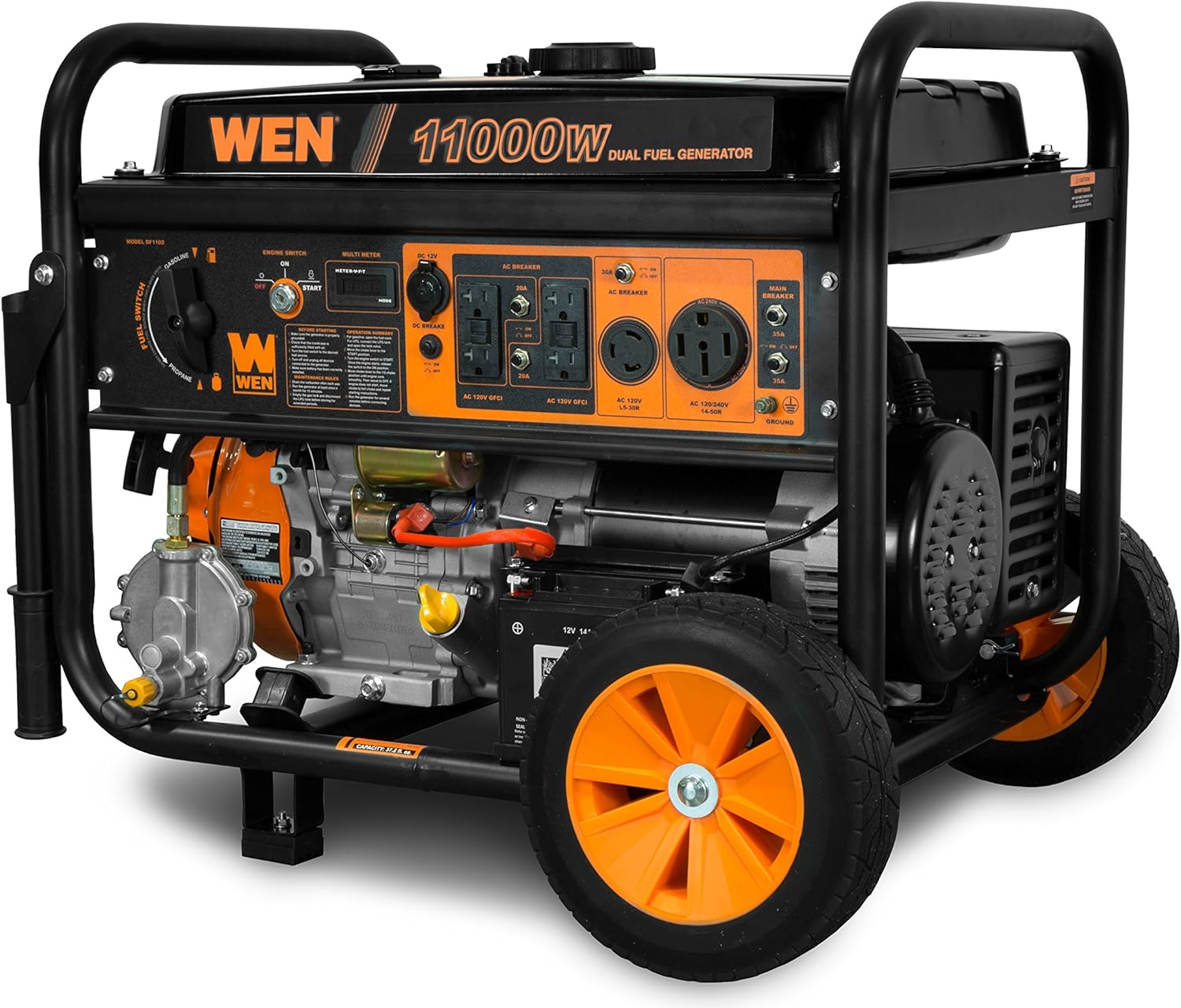
Power meets flexibility in the WEN 11,000-Watt 120V/240V Dual Fuel Portable Generator. This unit impressed me right away with its ability to run on either gasoline or propane, giving you a real choice depending on availability and cost. You’ll appreciate how easy the selection dial makes switching between fuels, especially when compared to other models that require clunky manual adjustments.
Voltage flexibility is another highlight, letting you toggle between 120V and 240V with no fuss. That means you can power transfer switches or large appliances without worrying about compatibility. I found this especially useful when testing it as an emergency backup source, something many budget competitors struggle to handle reliably.
Starting it couldn’t be simpler thanks to the electric start system. A quick turn of the key fired up the 457cc 4-stroke OHV engine every time during testing, saving you the hassle of pulling cords like with older models.
Its 6.6-gallon tank supports up to 8.5 hours of runtime at half load, which comfortably outlasts several similar generators in its class. I loved this during overnight runs because it eliminated the need for constant refueling.
Outlet variety stands out, too. Four 120V GFCI outlets, a 30A twist lock, a 50A outlet, and a 12V DC plug cover everything from basic household items to power-hungry tools. That breadth makes it more versatile than most mid-range options I’ve tested.
Transport feels manageable with its wheel and handle kit, though its weight still makes moving it solo challenging. What I loved most is its combination of dual fuel convenience, power output, and easy start reliability. In my experience, this generator sets a higher bar than many rivals.
3. Champion Power Equipment 4000-Watt Portable Generator

Compact power defines the Champion Power Equipment 4000-Watt Portable Generator. During testing, I found its weight of less than 49 pounds a game-changer, making it far easier to move than many heavier 4000-watt competitors. You’ll value that portability if you’re camping, tailgating, or just need a quick backup at home.
Noise levels stay controlled at 64 dBA from 23 feet, quieter than most standard units I’ve used. That makes conversations, music, or late-night use possible without constant irritation.
A 1.54-gallon fuel tank provides up to 10 hours of runtime at 25% load. That’s enough for full-day activities without constant refills, something bulkier alternatives often fail to match.
Clean electricity with less than 3% THD adds confidence when powering sensitive electronics. Laptops, phones, and even modern TVs stayed safe during my trials, unlike with cheaper, noisier models.
Outlet variety is another win. A TT-30R for RVs, a duplex outlet, a 12V automotive-style option, and parallel ports cover nearly every situation. Add the optional parallel kit, and you can double output for larger setups—perfect for pairing two units.
CO Shield safety stood out by shutting the unit down automatically when carbon monoxide levels spiked. That’s a feature missing in many budget competitors.
Handling without wheels can be awkward if you need to move it long distances.
What I loved most was its mix of portability, quiet operation, and clean power. This generator outperforms many rivals in real-world use.
4. PowerSmart 2500-Watt

Lightweight power rarely feels this convenient, and the PowerSmart 2500-Watt Portable Inverter Generator proves it. Weighing only 39.7 pounds, it’s far easier to carry than bulkier 2500-watt competitors, making it a practical choice for camping, tailgating, or quick use around your property. You’ll appreciate that built-in handle when moving it from one spot to another without strain.
Quiet operation stands out. At just 52 dBA from 23 feet under lighter loads, it’s quieter than most models in this range, so conversations remain comfortable. Even at full load, noise levels never reached distracting levels during testing.
Run time impressed me as well. At 50% load, you’ll get 5.5 hours, enough to handle typical evening events or emergencies without mid-use refueling.
Clean power with less than 3% THD adds confidence when running sensitive electronics. Charging phones, powering laptops, or keeping small appliances running felt safe and stable. Outlet options are also well-rounded: dual 120V receptacles, dual USB ports, a 12V DC outlet, and parallel connections for more power.
Eco Mode, Low Oil Shutdown, and Overload Reset provide added protection, while CO Protect brings peace of mind during extended use. Comparable models often skip one or two of these safeguards.
Starting requires a manual pull, which may not suit those preferring electric ignition.
What I loved most was its balance of portability, quiet design, and clean power. It simply delivers more usability than many rivals in its class.
5. Jackery Explorer 1000 v2

Compact, powerful, and fast—this little powerhouse kept my campsite running and my stress levels low, all without making a sound.
After putting the Jackery Explorer 1000 v2 Portable Power Station through real-life outdoor use and emergency prep, I was genuinely impressed by how quickly and reliably it delivered power. The one-hour fast charging is a standout feature—activate emergency mode in the Jackery App, and you’re fully charged from 0% to 100% in just 60 minutes. No gas. No noise. No waiting.
Despite its small footprint (just 23.8 lbs), it packed enough juice to run my cooler, charge my laptop and camera, and even brew morning coffee. That 1,070Wh capacity with 1,500W output and 3,000W surge is no joke—it handled multiple devices at once without blinking.
I was also impressed by the smart features. The Jackery app lets me toggle between silent night mode, eco mode, and full-speed charging. Everything was controlled from my phone, and it worked smoothly.
Built with a durable LiFePO4 battery, this power station is designed to last over 10 years with 4,000+ charge cycles. It’s got a solid range of ports too—two USB-C, one USB-A, car port, and three AC outlets—all delivering clean, stable power.
Whether you’re into RV life, prepping for emergencies, or just want reliable backup at home, this unit is an ideal pick. It’s lightweight, lightning-fast to recharge, and packed with smart features—and in the video, I show exactly how it performs in real scenarios.
Best Portable Generator: Your Complete Buying Guide
Introduction
When the lights go out or when you need reliable power on the go, a portable generator can make all the difference. These compact machines are designed to deliver electricity wherever and whenever you need it. Whether you’re camping in the wilderness, tailgating before a big game, working at a job site without access to power, or dealing with an unexpected power outage at home, a portable generator ensures you stay connected and productive.
Imagine a storm knocks out your home’s electricity for hours—or even days. Without a backup power source, your fridge could spoil, your devices could die, and your sense of safety could quickly fade. A portable generator keeps the essentials running: lights, phones, medical devices, and even small appliances. On the other hand, outdoor enthusiasts see portable generators as freedom machines, giving them the ability to use electric stoves, laptops, and speakers in the middle of nowhere.
Unlike standby generators, which are permanently installed and automatically switch on during blackouts, portable generators are mobile, flexible, and much more affordable. They offer different sizes, fuel types, and capacities, making them suitable for everything from powering a single tool to running a household during emergencies.
The beauty of portable generators lies in their versatility. Compact models slip easily into your car trunk for camping trips, while larger ones can keep your home appliances humming when the power grid falters. Advances in technology have also made them quieter, more fuel-efficient, and cleaner for the environment. Some even come with smart features such as Bluetooth monitoring or dual-fuel capability.
In short, owning a portable generator is about peace of mind, independence, and convenience. It ensures that your life isn’t disrupted when the unexpected happens, while also opening opportunities for leisure and work beyond the reach of traditional power outlets. In this guide, we’ll explore the different types of portable generators, key features you should consider, and practical buying tips to help you choose the perfect model for your needs.
Types of Portable Generators
Portable generators come in various forms, each designed to suit specific scenarios and power requirements. Here are the most common types:
1. Conventional Portable Generators
These are the classic models most people think of. They run on gasoline or diesel and produce power through an internal combustion engine connected to an alternator. They’re excellent for general backup at home or job sites, offering higher wattage than compact models. However, they can be noisy and less fuel-efficient. Ideal for homeowners needing temporary backup and contractors powering heavy-duty tools.
2. Inverter Generators
Inverter generators are newer, more advanced, and highly efficient. They produce “clean power,” making them safe for sensitive electronics like laptops, smartphones, and medical devices. They are also much quieter, compact, and fuel-efficient compared to conventional types. Perfect for campers, RV users, or anyone who values quiet operation and portability.
3. Dual-Fuel Generators
As the name suggests, these generators can run on two different fuels, typically gasoline and propane. This versatility allows you to switch fuel sources depending on availability and cost. They’re a great option for people who want flexibility during emergencies or long trips.
4. Solar Generators (Battery-Powered)
Solar-powered generators use solar panels to charge an internal battery. They’re eco-friendly, silent, and safe for indoor use since they produce no emissions. While they typically provide lower wattage than fuel-powered models, they’re great for charging small electronics or running light appliances. Best for eco-conscious users, campers, and emergency preparedness kits.
5. Heavy-Duty Portable Generators
These are large-capacity models designed for high-demand scenarios, such as running multiple home appliances during extended outages or powering demanding job sites. They’re less portable but provide a reliable alternative to permanent standby generators.
Key Features to Look For
Power Output (Wattage)
Measured in watts, power output determines what and how many devices a generator can run. A 2,000-watt generator may power a fridge and some lights, while a 7,500-watt unit can handle multiple appliances at once.
Fuel Type and Tank Size
The type of fuel—gasoline, propane, diesel, or solar—affects cost, availability, and convenience. Tank size impacts how long the generator runs before refueling. Larger tanks are better for long outages, while smaller tanks keep the unit lighter.
Noise Level
Generators can be loud, which is problematic in residential areas or campsites. Inverter generators and solar models are significantly quieter, often running at a gentle hum.
Portability and Design
Wheels, handles, and overall weight matter if you need to move the generator frequently. Compact, lightweight models are best for travel, while heavier ones may need built-in mobility features.
Safety Features
Look for features like automatic shut-off when oil is low, circuit breakers to prevent overloads, and carbon monoxide detectors for added protection.
Bonus Features
Modern generators often come with USB ports, remote start, Bluetooth monitoring, or parallel capability (linking two generators for more power). While not essential, these features add convenience.
Things to Consider Before Buying
Budget
Portable generators vary widely in price. Small inverters can cost around $300–$500, while heavy-duty dual-fuel units may reach $1,500 or more. Balance your budget with your power needs—buying too small will leave you frustrated, while overspending on unused capacity wastes money.
Size and Space
Think about where you’ll store and use the generator. Compact models fit easily in closets or vehicles, while larger units require dedicated space in your garage or shed.
Ease of Use
From pull-start engines to push-button electric starts, ease of use varies. If you want convenience, look for electric start or remote control options. Dual-fuel units may also require more setup.
Durability and Warranty
Generators are an investment. Choose a model with a strong frame, durable materials, and a decent warranty. Check if replacement parts and service centers are easily available.
Pros and Cons
| Pros | Cons |
|---|---|
| Provides backup power during outages | Can be noisy, especially conventional models |
| Portable and versatile for travel or work | Fuel storage and refilling can be inconvenient |
| Wide variety of options for different needs | Higher-capacity models are heavy and less mobile |
| Inverter and solar models are quiet and eco-friendly | Solar and small inverters may not power large appliances |
Step-by-Step Buying Guide
1. Research Your Needs
Start by listing the devices or appliances you want to power. Add up their wattage requirements to determine the generator size you need. Consider whether you’ll use it mainly for home backup, camping, or job sites.
2. Compare Products
Check specifications carefully. Read reviews, watch demonstrations, and compare prices across brands. Pay attention to reliability, noise levels, and fuel efficiency.
3. Finalize Your Choice
Before purchasing, check warranty terms, customer support, and availability of spare parts. Consider buying from reputable retailers that offer return policies or extended service plans.
Maintenance Tips
-
Run it regularly: Even when not in use, start the generator every month to keep the engine in good shape.
-
Use fresh fuel: Stale gasoline can damage the carburetor. Use stabilizers if storing fuel long-term.
-
Keep it clean: Wipe dust, check air filters, and store it in a dry, covered area.
-
Avoid overloading: Never plug in more than the rated capacity. It can damage both the generator and your appliances.
-
Check oil and spark plugs: Regularly change oil and inspect spark plugs for wear to ensure smooth operation.
Common Issues and Troubleshooting
-
Generator won’t start: Check fuel level, spark plug condition, and oil levels.
-
Appliances not running properly: Ensure you’re not exceeding wattage capacity and verify that voltage is steady.
-
Excessive noise: Place the generator on a flat surface and use noise-reducing mats if necessary.
-
Fuel leaks or smells: Inspect hoses and connections; replace damaged parts immediately.
Final Words
A portable generator is more than just a machine—it’s a safety net and a convenience tool rolled into one. Whether you’re preparing for emergencies, powering outdoor adventures, or keeping your job site running smoothly, the right generator ensures you’re never left in the dark. Focus on features that align with your needs—whether that’s quiet operation, dual-fuel versatility, or heavy-duty power capacity. With careful research and regular maintenance, your portable generator will be a reliable companion for years to come.