

“Splintered cuts, wandering blades, and frustrating straight-line struggles are silently ruining your woodworking projects and professional reputation every single day. Today, we test the best track saws available, delivering razor-sharp precision, flawless straight cuts, and cabinet-quality results that completely transform how you approach every single sheet material cutting task forever.”
Top 5 Track Saws:
1. Festool TS 55 Track Saw

Every serious woodworker eventually discovers this saw changes everything. Festool TS 55 delivers precise, splinter-free, glue-ready cuts across plywood, MDF, veneered boards, melamine panels, flooring, and solid hardwood without a single setup compromise. You get Multiple Material Control electronics adjusting blade speed from 2,000 to 5,200 RPM, maintaining constant velocity under load for perfectly smooth results every single pass. Dual splinter guards — one on the guide rail and one on the blade side — eliminate tearout completely on both cut edges simultaneously. FastFix blade changes lock the power switch off automatically, secure the arbor, and position the blade for removal in seconds without hunting for tools. Dust collection captures over 90% of fine particles when connected to a compatible vacuum, making indoor cuts genuinely clean on critical finish surfaces. A spring-loaded riving knife prevents blade pinching and eliminates kickback throughout every plunge cut you make. Bevel adjustment spans -1 to 47 degrees, maintaining consistent cutting depth even when tilted for flooring, baseboard, or stair tread applications. What we love most is how this portable saw confidently replaces a full table saw, panel saw, and miter saw on any job site. Proprietary dust port compatibility requires Festool extractors or additional adapters for standard vacuum connection. Choose TS 55 when absolute precision, clean cuts, and professional performance across all material types define your daily work.
2. Bosch GKT13 Tools Track Saw
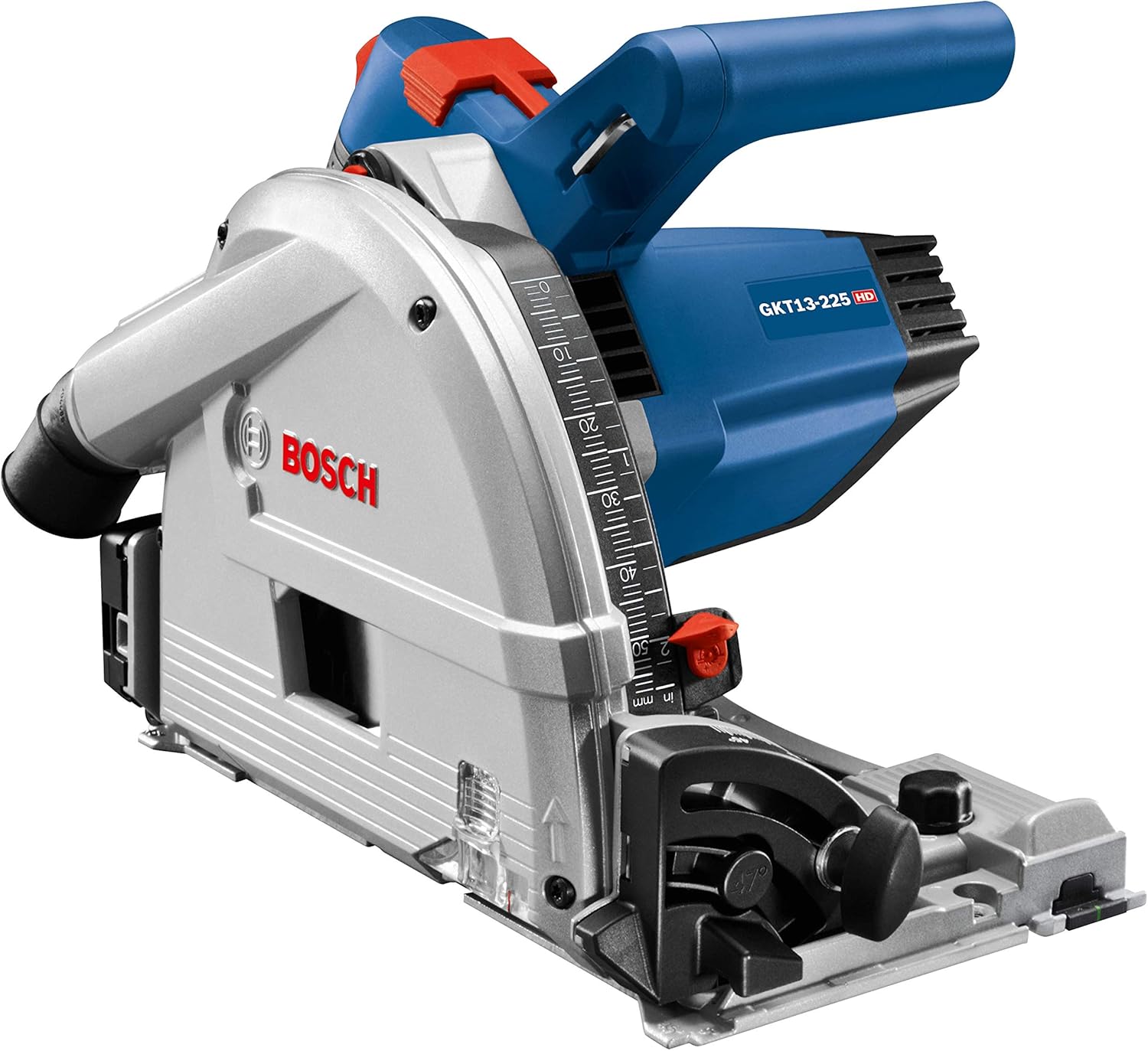
Precision German engineering finally arrived in the track saw market — and it arrived impressively. Bosch GKT13-225L delivers table-saw quality cuts across plywood, laminated particle board, and hardwood sheet goods with confidence-inspiring accuracy from every first pass. You benefit from constant electronics maintaining blade speed consistently under demanding load conditions, preventing the bogging that plagues lesser competing models during difficult cuts. Overload protection guards the motor automatically against overheating during extended cutting sessions through dense or thick material. A swiveling dust port keeps your vacuum hose completely clear of the cutting path during long full-sheet rip cuts without tangling or snagging. Three-step blade changes complete in under a minute using the integrated spindle lock and onboard hex key stored right on the saw body. Front and rear tracking adjustment knobs dial in a precise fit between the saw base and FSN rail system, eliminating any detectable movement or play. Bevel range reaches -1 to 47 degrees from a single pivot point, keeping track positioning identical for both straight and angled cuts. A 12.5-foot power cord provides extended working range across diagonal 4×8 sheet cuts without any frustrating cord-length restrictions. What impresses most is the zero-runout precision fit between saw body and rail — genuinely no movement during cuts. Some units have shipped with non-flat base plates, affecting initial cut accuracy before correction. Invest in GKT13 when German engineering precision at a mid-range track saw investment matters most to you.
3. DEWALT DWS520 TrackSaw

Sheet goods have never been easier to break down accurately and cleanly. DEWALT DWS520 TrackSaw delivers table-saw precision combined with circular-saw portability, producing splinter-free cuts across plywood, flooring panels, cabinetry components, and hardwoods without wrestling material onto a stationary saw. You power through hardwoods up to 2-1/8 inches thick using a reliable 12-amp 1,300-watt motor that maintains consistent speed without bogging under load. A continuous anti-kickback mechanism and spring-loaded riving knife work together, providing layered safety protection that most rival track saws offer only partially. Zero-clearance dual-edged tracks produce perfectly straight cuts in both directions simultaneously, letting you flip workpieces for either edge without repositioning the rail. Cutting depth reaches 2-1/8 inches at 90 degrees and 1-5/8 inches at 45 degrees, covering virtually every common sheet goods application encountered on real job sites. A 360-degree swiveling dust port connects to standard shop vacuums and achieves better-than-90% dust extraction during indoor cuts through finished spaces. Thick magnesium base construction provides a solid, stable feel that rivals the Festool TS 55 during extended cutting sessions. Low-profile blade guard allows cutting in genuinely confined spaces that competing track saws cannot physically access. Ergonomics are arguably the best in class — comfortable overmolded handles and intuitive controls reduce fatigue during full-day use. No positive bevel stop exists at 45 degrees, requiring extra manual verification for accurate angled cuts. Choose DWS520 when best-in-class ergonomics and professional track-saw performance at an accessible investment define your top priorities.
4. Makita SP6000J1

Festool-level precision is no longer exclusive to a Festool budget. Makita SP6000J1 pairs a powerful 12-amp motor with magnesium components, delivering a 9.7-pound package that outperforms similarly priced rivals across every cutting application. You achieve mirror-finish, splinter-free results on sheet goods, countertops, trim, flooring, and interior doors using electronic speed control, maintaining constant blade velocity under varying load conditions. Variable speed adjustment from 2,000 to 5,200 RPM lets you optimize performance for hardwood, softwood, laminate, and composite materials without changing blades or settings. A built-in 1/16-inch preliminary scoring pass scores the surface before full plunge, eliminating any tearout risk on veneered, melamine, or laminated panels completely. Bevel range reaches -1 to 48 degrees with firm positive stops at 22.5 and 45 degrees, while dual front and rear bevel supports add rigidity during angled cuts for consistent results. Close-to-wall capability reaches just 11/16-inch clearance, making door undercutting, flooring installation, and wall-adjacent cabinet cuts genuinely practical. A soft start motor prevents sudden blade grab on startup, protecting both the material surface and operator control during every plunge. A built-in torque limiter prevents motor burnout automatically during aggressive cuts in dense hardwood. What we love most is Makita’s comprehensive accessory ecosystem — multiple rail lengths, connectors, clamps, and adapters integrate seamlessly with this saw. Rail connectors joining two guide rails don’t align as smoothly as Festool’s system during extended 8-foot-plus continuous cuts. Buy SP6000J1 when professional track-saw precision at a realistic budget represents your most important buying consideration.
5. WEN CT1065

A table saw alternative doesn’t need to cost a fortune — and WEN proves it decisively. WEN CT1065 brings genuine track-saw capability to budget-conscious woodworkers who want clean, straight cuts without overcommitting financially on a rarely used tool. You power through plywood, doors, furniture panels, and standard lumber using a 10-amp motor spinning the 6.5-inch blade at 5,500 RPM consistently across common hardwoods. Three distinct blade position settings handle shallow 1/8-inch scoring cuts, full plunge cuts, and blade changes separately without any tool swapping or complicated adjustments. Non-slip base cams grip the workpiece during cuts, reducing pinching and minimizing kickback risk for users newer to plunge saw operation. Bevel adjustment reaches 45 degrees for angled cuts in boards up to 1-5/8 inches thick, covering standard trim and flooring bevel applications. Depth gauge adjusts from 0 to 2-1/3 inches, giving precise control over plunge depth for partial cuts, dados, and full through-cuts. Compatibility with multiple track brands provides flexibility that proprietary systems from Festool and Makita deliberately restrict. A 1.5-inch dust port accepts standard shop vacuum connections, keeping the work surface reasonably clean during cuts. What genuinely surprises most is how accurately CT1065 performs on straightforward full-sheet rip cuts compared to saws costing three to four times more. Plastic construction throughout feels noticeably less durable than metal-bodied alternatives from Bosch, DEWALT, and Makita during demanding or repetitive professional use. Choose CT1065 if you want real, functional track-saw performance for weekend DIY projects without unnecessary financial overcommitment.
Best Track Saw Buying Guide: How to Choose the Right Track Saw for Your Woodworking Projects
A track saw is one of the most useful tools for making long, straight, and accurate cuts in large sheets of wood. Unlike a traditional circular saw, a track saw runs along a guide rail that keeps the blade precisely on the cutting path. This makes it especially useful for cutting plywood, MDF, hardwood panels, doors, countertops, and other large materials.
For woodworkers, a track saw can make difficult sheet-goods work much easier. Instead of trying to support a large plywood sheet on a table saw, you can place it on a suitable work surface and make accurate cuts from above. This is particularly helpful when working alone.
Track saws are also excellent for cabinetmaking and furniture construction. Clean, straight cuts are essential when several panels need to fit together precisely. A quality track saw can reduce the amount of additional trimming and correction required after cutting.
Another major advantage is the plunge-cutting capability. Unlike a conventional circular saw that normally starts at the edge of a workpiece, a track saw can plunge directly into the material. This makes it useful for cutting openings, trimming countertops, shortening doors, and creating interior cuts.
Modern track saws are available in both corded and cordless configurations. Corded models are well suited to workshops where continuous power is important, while cordless models provide greater freedom on construction sites and remote work areas.
The guide rail is an equally important part of the system. A high-quality rail provides a straight reference surface and helps the saw maintain a consistent cutting path. Some rails also include anti-slip strips and replaceable splinter guards for cleaner and safer cuts.
When choosing a track saw, you should consider more than motor power. Cutting depth, bevel capacity, plunge action, rail compatibility, dust extraction, ergonomics, blade quality, and safety features all affect real-world performance.
Your choice should also depend on how often you use the tool. An occasional DIY user may not need an expensive professional system, while a cabinetmaker or contractor who uses a track saw every day can benefit from investing in a premium model.
Battery compatibility is another important consideration for cordless users. If you already own several cordless tools from a particular brand, choosing a track saw that uses the same battery platform can reduce the cost of purchasing additional batteries and chargers.
The size and weight of the saw also matter. A lightweight model can be easier to handle during long cuts, while a heavier design may provide greater stability. Good weight distribution and an ergonomic grip can make a significant difference during extended use.
Dust collection should not be overlooked. Cutting plywood and MDF can generate large quantities of fine dust, so a saw with an effective dust port can help maintain visibility and keep the work area cleaner.
Blade selection is equally important. A track saw with a high-quality blade can produce remarkably clean cuts, while a dull or inappropriate blade can cause splintering, burning, and slow cutting.
Before purchasing, consider the complete system rather than just the saw. You may need guide rails, rail connectors, clamps, additional blades, batteries, chargers, and a dust extractor.
With the right combination of features and accessories, a track saw can provide many of the advantages of a table saw while remaining considerably more portable.
Types of Track Saws
Track saws generally fall into a few major categories, and each type is designed for different working environments and users.
Corded Track Saws
Corded track saws connect directly to an electrical outlet and provide continuous power. They are ideal for workshop users who frequently make long or repeated cuts and don’t want to stop to recharge batteries.
They are particularly suitable for cabinetmakers, furniture builders, and serious hobbyists. Their main disadvantage is that the power cord can restrict mobility and may require an extension cord when working away from an outlet.
Cordless Track Saws
Cordless track saws operate using rechargeable batteries. They are ideal for contractors, remodelers, and woodworkers who frequently work at different locations.
The biggest benefit is freedom of movement. However, battery runtime becomes an important consideration, especially when cutting thick hardwood or repeatedly processing large sheets.
Professional Track Saws
Professional models are designed for demanding daily use. They typically offer excellent plunge mechanisms, precise rail adjustment, strong dust extraction, advanced safety features, and durable construction.
They are best suited to professional woodworkers, cabinetmakers, contractors, and users who depend on consistent performance.
Budget Track Saws
Budget-friendly models are designed for occasional woodworking and DIY applications. They may not offer the same refinement or accessory ecosystem as premium systems, but they can still provide accurate straight cuts at a lower initial cost.
They are a good option for users who don’t need a track saw every day.
Key Features to Look For
Cutting Depth
Cutting depth determines how thick a material the saw can cut in one pass. For most plywood, MDF, and cabinet work, a cutting depth around 2 inches is generally sufficient.
If you regularly work with thick hardwood or heavy construction materials, choose a model with greater cutting capacity.
Remember that cutting depth decreases when making bevel cuts, so check both the 90-degree and angled specifications before buying.
Guide Rail Compatibility
The guide rail is one of the most important components of a track saw system.
Look for rails that are straight, rigid, and easy to position. Anti-slip strips can help keep the rail securely on the workpiece, while splinter guards help reduce chipping along the cut line.
Also check how easily the rail can be extended. If you frequently cut full sheets, joining two shorter rails may be more convenient than purchasing one extremely long rail.
Plunge Mechanism
A smooth plunge mechanism gives you better control when starting a cut in the middle of a panel.
The mechanism should move smoothly without excessive resistance or side-to-side movement. A controlled plunge is particularly important for precision furniture and cabinet work.
Bevel Adjustment
A good track saw should offer adjustable bevel cutting for angled applications.
A range around 45 degrees is useful for furniture, trim, doors, and other projects requiring angled cuts. Make sure the bevel mechanism locks securely and maintains its setting during operation.
Motor Power
Motor power affects how easily the saw handles different materials.
A powerful motor is useful when cutting hardwood, thick panels, and multiple layers of material. However, motor power should not be the only factor you consider.
A well-designed saw with good blade control can outperform a more powerful model with poor ergonomics or an inaccurate rail system.
Dust Extraction
A good dust collection system improves visibility and reduces airborne dust.
Look for a well-designed dust port that can connect securely to your shop vacuum or dust extractor. If you frequently cut MDF or other dusty sheet materials, effective extraction should be a high priority.
Blade Quality
The blade determines much of the final cut quality.
For plywood and veneered panels, a fine-tooth blade can help produce cleaner edges. For thicker solid wood, a blade designed for efficient ripping may be more appropriate.
Choose replacement blades according to the material and type of cut rather than using one blade for every application.
Ergonomics
A track saw should feel comfortable and balanced in your hands.
Look for a comfortable grip, easily accessible controls, and a weight that you can manage throughout a long cut. Poor ergonomics can cause fatigue and make it more difficult to maintain consistent control.
Safety Features
Safety should always be a major consideration.
Useful features can include blade guards, electronic braking, anti-kickback systems, riving-knife-style mechanisms, and controlled startup systems.
Always follow the manufacturer’s safety instructions and use appropriate eye, hearing, and respiratory protection.
Things to Consider Before Buying
Budget
Track saw prices vary considerably depending on the quality, power source, and included accessories.
Entry-level systems can be suitable for occasional DIY projects, while mid-range models provide better accuracy and durability for frequent woodworking.
Premium systems can cost considerably more, but they often provide better rail systems, plunge mechanisms, dust extraction, safety features, and long-term durability.
Don’t compare only the price of the saw. Calculate the cost of the complete setup, including the rail, blades, batteries, charger, clamps, and extraction equipment if necessary.
Workspace
A major advantage of a track saw is that it requires less permanent space than a table saw.
However, you still need enough room to support the material and position the guide rail correctly.
If you frequently cut full sheets of plywood, make sure your workshop has enough floor or bench space to support the entire panel safely.
Corded or Cordless
Choose a corded model if you primarily work in a workshop and want uninterrupted cutting.
Choose cordless if you frequently work on construction sites, outdoors, or in areas where electrical outlets are inconvenient.
For cordless models, consider battery cost and runtime as part of the overall purchase.
Rail Length
The length of the rail should match the materials you normally cut.
A shorter rail may be convenient for doors and smaller panels, while a longer rail is useful for full sheets.
If possible, choose a system that allows multiple rails to be joined securely.
Brand Ecosystem
Consider the availability of accessories and replacement parts.
A good ecosystem should provide compatible rails, connectors, blades, clamps, batteries, and other accessories without making future purchases difficult.
Step-by-Step Buying Guide
1. Research Your Needs
Start by identifying what you plan to cut and how frequently you expect to use the saw.
If your projects mainly involve plywood and MDF, prioritize clean cutting, rail accuracy, and dust extraction.
If you build furniture, focus on precision, plunge control, bevel adjustment, and blade quality.
If you’re a contractor, portability, battery life, durability, and jobsite convenience may be more important.
Also consider whether you already own cordless tools. Staying within the same battery platform can make a cordless track saw significantly more convenient.
2. Compare Products
Once you’ve identified your requirements, compare several models rather than choosing based on price alone.
Pay particular attention to cutting depth, rail compatibility, plunge action, bevel range, dust collection, weight, safety features, and warranty coverage.
Read customer feedback with a focus on long-term reliability rather than only first impressions.
Also check the availability and price of replacement blades and guide rails. A product may appear inexpensive initially but become costly if its accessories are difficult to find.
3. Finalize Your Choice
Before purchasing, confirm that the saw will work with the materials you normally cut.
Check the complete package and determine whether a guide rail is included. If it isn’t, include the cost of one in your budget.
For cordless models, check whether a battery and charger are included.
Finally, review the warranty and return policy. Buying from a reputable retailer can make it easier to obtain replacement parts or service if something goes wrong.
Maintenance Tips
Keep the Guide Rail Clean
Dust and debris underneath the rail can affect stability and cutting accuracy. Clean the rail regularly and inspect the anti-slip strips for wear.
Clean the Saw After Use
Remove sawdust from the blade housing, plunge mechanism, vents, and dust port. Excessive buildup can affect performance and movement.
Maintain the Blade
Inspect blades regularly for dull or damaged teeth. A dull blade increases cutting resistance and can produce rough edges or burn marks.
Check Rail Adjustment
If the saw has adjustable guide-rail fittings, periodically check them for excessive movement. The saw should slide smoothly while remaining firmly connected to the rail.
Store Properly
Keep the saw, rails, blades, and accessories in a dry environment. Avoid placing heavy objects on guide rails, as bending a rail can seriously affect cutting accuracy.
Common Issues and Troubleshooting
The Saw Wanders From the Cutting Line
Check that the saw is properly adjusted to the rail and that the rail itself is securely positioned.
The Cut Edge Is Splintering
Use a blade designed for clean panel cuts, make sure the blade is sharp, and check the condition of the rail’s splinter guard.
The Saw Produces Burn Marks
A dull blade, excessive feed pressure, or an inappropriate blade can cause overheating. Inspect the blade and use one appropriate for the material.
The Saw Is Difficult to Plunge
Check for sawdust buildup around the plunge mechanism and make sure the depth adjustment is correctly positioned.
Dust Collection Is Poor
Inspect the dust port, hose, and extractor for blockages. Empty or clean the extractor if necessary.
Cordless Battery Runs Out Quickly
Dense materials and repeated deep cuts consume more power. Use a higher-capacity battery and keep a spare charged battery available for demanding jobs.
Final Words
Choosing the best track saw can make a significant difference in the speed, accuracy, and quality of your woodworking projects. The right model gives you the ability to make long, clean, repeatable cuts without the bulk of a traditional table saw.
Start by identifying your projects, materials, workspace, and expected frequency of use. Then decide whether a corded or cordless design makes more sense for your working environment.
Pay close attention to the guide rail, because it is just as important as the saw itself. Cutting depth, plunge control, bevel adjustment, dust extraction, ergonomics, blade quality, and safety features should also influence your decision.
Most importantly, don’t automatically choose the most expensive model. A premium professional system can be worthwhile for daily woodworking, but a capable mid-range or budget track saw may provide better value for occasional DIY projects.
The best track saw is ultimately the one that matches your actual needs. Choose a reliable system, use the correct blade, maintain the rail and saw properly, and you’ll have a versatile tool capable of handling everything from simple plywood cuts to demanding furniture and cabinet projects.