

Your audio system sounds flat, weak, and completely lifeless without a quality subwoofer anchoring every single note. Today, we test the best subwoofers available, delivering earth-shaking bass that transforms ordinary listening into extraordinary experiences. No more thin, disappointing sound from expensive speakers that simply cannot reproduce deep, powerful low frequencies properly.”
Top 5 Subwoofers:
1. Klipsch R-100SW

Big bass, bold impact. Klipsch R-100SW delivers room-shaking performance that stands above many entry-level subwoofers. You immediately feel how this Klipsch R-100SW fills space with deep, controlled low-end energy.
Sound quality impresses through a 10-inch spun-copper IMG woofer, producing tight, clean bass with minimal distortion. An all-digital amplifier pushes up to 300 watts peak power, giving you strong output without losing clarity. Frequency response reaches down to 32Hz, letting you hear deeper tones that smaller units often miss.
Placement feels flexible thanks to the front-firing design, allowing consistent performance across different room positions. Controls for volume, low-pass crossover, and phase help you fine-tune output for better blending with your speakers. LFE RCA inputs ensure easy connection with most home theatre receivers.
Build quality feels solid, and the cabinet design keeps vibrations controlled during heavy playback sessions. What I love most is how it balances power with precision, avoiding muddy bass.
Size may feel slightly large for compact spaces, especially in smaller rooms. Overall, you get a powerful subwoofer that delivers deep, accurate bass with strong reliability.
2. SVS SB-1000 Pro

Deep, precise, and powerful. SVS SB-1000 Pro Sealed Subwoofer redefines what compact bass systems can achieve. You quickly hear how this SVS SB-1000 Pro Sealed Subwoofer outperforms many larger competitors.
Output feels strong thanks to a 325 watts RMS amplifier with over 820 watts peak power. Sledge STA-325D design combines MOSFET output with Class D efficiency, delivering clean energy without strain. A 12-inch high-excursion driver moves serious air, producing deep lows with excellent control.
DSP tuning powered by a 50MHz Analog Devices processor keeps frequency response accurate across different room setups. Smartphone app control makes adjustments simple, letting you fine-tune volume and presets without touching the unit. Sealed cabinet design reduces distortion, giving tighter bass compared with ported alternatives.
Build quality feels premium, with rigid bracing that limits vibration during heavy playback sessions. What I love most is how it balances force with detail, keeping the bass musical.
A compact enclosure may require careful placement to unlock full room-filling potential. Overall, you get a high-performance subwoofer that blends precision, power, and smart control in one refined package.
3. JBL Stage 2

Punchy bass, clean impact. JBL Stage 2 delivers strong low-end performance that stands out in its class. You quickly hear how this JBL Stage 2 competes well with similarly priced subwoofers.
A 10-inch polycellulose ribbed cone woofer produces deep, controlled bass with solid accuracy. The ribbed design adds stiffness, helping reduce distortion during louder playback sessions. Built-in amplifier delivers 150W RMS and 300W dynamic power, giving enough force for movies and music.
Dual rear-firing tuned ports improve airflow, allowing deeper extension compared with sealed designs. Placement feels flexible, letting you position it in different spots without losing much performance. Controls for crossover, level, and phase help you match output with your existing speakers easily.
Sound feels balanced, offering both impact and clarity without becoming muddy at higher volumes. What I love most is how it fills a room with bass while keeping detail intact.
Cabinet size may feel slightly bulky for tighter setups, especially in smaller living areas. Overall, you get a capable subwoofer that combines strong output, flexible tuning, and reliable performance for everyday listening.
4. Audioengine S8
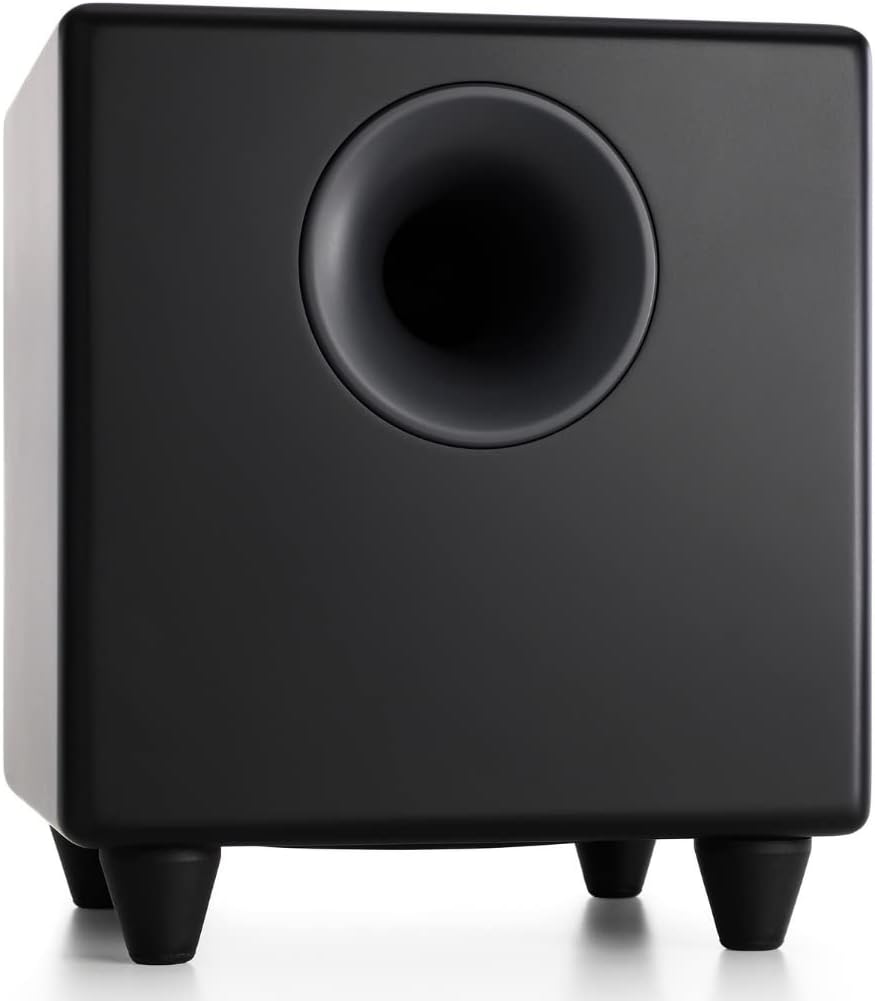
Compact size, serious bass. Audioengine S8 delivers impressive low-end performance that surprises for its footprint. You quickly notice how this Audioengine S8 fits easily where larger subwoofers struggle.
Output feels strong with 250 watts of power, giving enough punch for movies, music, and gaming setups. Down-firing design spreads bass evenly, creating deeper resonance compared with front-firing alternatives. Sound remains tight, avoiding the boominess found in many small subs.
Placement flexibility stands out, letting you position it without worrying about losing impact. Sleep mode adds convenience by powering down automatically when idle, saving energy during downtime. Wireless readiness offers upgrade potential, allowing cleaner setups with fewer visible cables.
Performance works well for both home theater and studio use, delivering balanced bass across different content types. What I love most is how it blends power with compact design, making it easy to integrate anywhere.
Lower frequency extension does not reach as deep as larger models, especially in bigger rooms. Overall, you get a compact subwoofer that combines solid output, flexible placement, and clean bass performance effectively.
5. Polk Audio PSW10
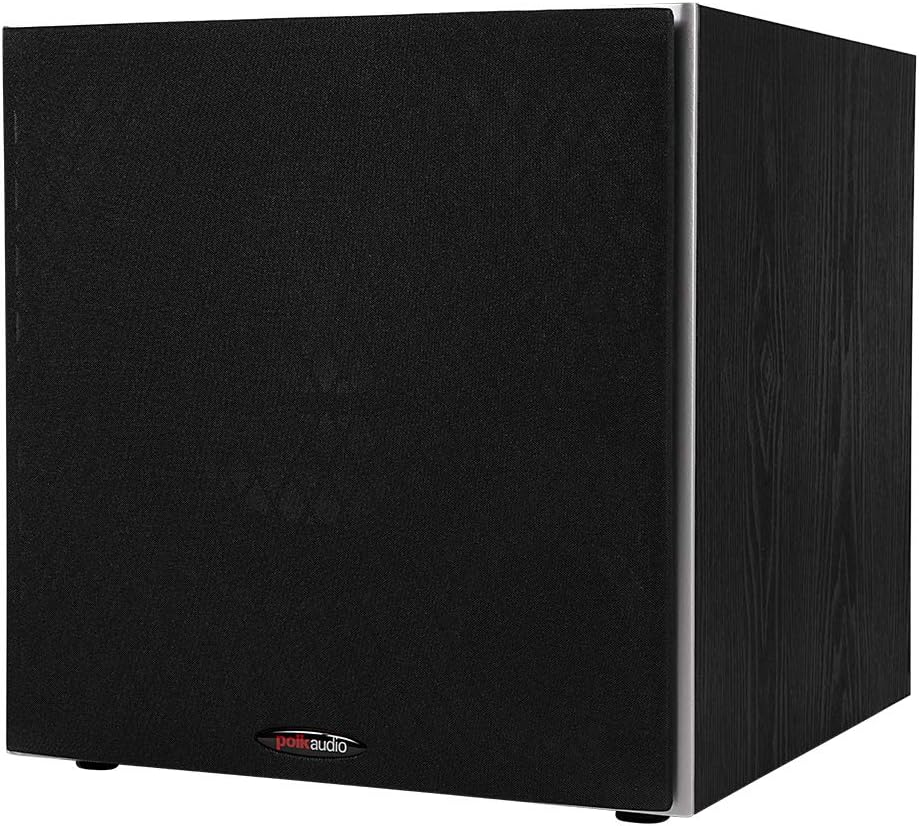
Punchy bass on a budget. Polk Audio PSW10 delivers solid low-end performance that fits easily into smaller setups. You quickly notice how this Polk Audio PSW10 competes well with pricier entry-level subwoofers.
A 10-inch Dynamic Balance woofer produces clean bass with good depth for music and movies. Ported design improves airflow, helping low frequencies sound fuller without distortion. Output stays clear even at higher volume, avoiding muddiness common in cheaper units.
Built-in amplifier provides 50 watts RMS with 100 watts peak power, giving steady performance for daily listening. Crossover controls allow smooth blending with existing speakers, making integration simple and effective. Frequency response reaches low enough to add real impact in small-to-mid rooms.
Connectivity options feel flexible, supporting both line-level and speaker-level inputs for easy setup. Phase switch helps align output when using multiple speakers or subs. What I love most is how it delivers reliable bass without taking up much space.
Deep bass extension may feel limited compared with larger, more powerful models. Overall, you get a dependable subwoofer that offers clean sound, easy setup, and great value for everyday use.
Feel Every Beat: The Ultimate Buying Guide to the Best Subwoofers
Introduction
There is a moment every audio enthusiast knows — the first time they hear a system with a truly great subwoofer. The bass does not just reach your ears; it moves through your chest, fills the room, and transforms music, movies, and games from something you listen to into something you physically experience. That is the difference a quality subwoofer makes, and once you have heard it, ordinary audio feels permanently incomplete by comparison.
Most speakers — even excellent, high-quality ones — simply cannot reproduce the lowest frequencies of the audio spectrum accurately or powerfully. The human ear perceives sound between roughly 20Hz and 20,000Hz, but standard stereo speakers typically struggle to deliver anything below 80Hz with meaningful impact. Bass guitars, kick drums, pipe organs, cinematic explosions, rumbling thunder, and the deep electronic pulses of modern music all live in that lower register. Without a dedicated subwoofer, these sounds are either absent entirely or rendered as thin, unsatisfying approximations of what the artist or sound designer intended.
A subwoofer is a dedicated loudspeaker built for one purpose: reproducing low-frequency audio with power, accuracy, and depth. By handing off everything below a set frequency crossover point to the subwoofer and letting your main speakers focus on midrange and treble, every element of the audio spectrum gets the attention it deserves. The result is a fuller, more balanced, more immersive sound that reveals details in your favourite recordings you may never have noticed before.
For home theatre enthusiasts, a subwoofer is not a luxury — it is essential. Action films, science fiction epics, and animated features are mixed with deep, powerful bass that forms a critical layer of the cinematic experience. Without a subwoofer, you are hearing an incomplete version of the soundtrack the filmmakers intended. A well-integrated subwoofer restores that missing dimension, making every scene land with the emotional and physical impact it was designed to deliver.
Music lovers benefit just as profoundly. Whether you prefer jazz, hip-hop, classical, rock, electronic, or anything in between, virtually every genre contains low-frequency content that a subwoofer reveals in ways bookshelf or floor-standing speakers alone cannot. Basslines become tighter and more articulate. Kick drums have real weight and impact. Orchestral recordings gain the full grandeur of the concert hall. The listening experience becomes richer, more dynamic, and more emotionally engaging across every genre you love.
Gamers, too, have discovered the transformative effect of a quality subwoofer. Modern game soundtracks and effects are designed with deep bass in mind — the rumble of an engine, the concussion of an explosion, the ominous thrum of an approaching enemy. A subwoofer translates these sound cues from abstract audio events into visceral, spatial experiences that actually improve gameplay by making the sonic environment more realistic and detailed.
With so many subwoofers on the market — from compact powered units for small apartments to massive passive monsters for dedicated home theatres — choosing the right one requires understanding your space, your system, and your listening priorities. This guide gives you everything you need to make that decision with confidence.
Types of Subwoofers
Subwoofers come in several distinct categories based on their design, power source, and intended application. Understanding these types is the essential first step toward matching the right subwoofer to your room, your system, and the way you actually listen.
Type 1: Powered (Active) Subwoofers
Powered subwoofers contain a built-in amplifier matched specifically to the driver inside the cabinet. They connect directly to a receiver or amplifier via a single line-level cable, making them the simplest and most popular choice for home theatre and music listening setups. Because the internal amplifier is engineered to work optimally with the specific driver and cabinet design, powered subwoofers tend to deliver consistent, predictable performance without requiring external amplification knowledge or additional equipment. They are the ideal choice for most home listeners, from casual movie watchers to serious audiophiles, and represent the vast majority of subwoofers sold for home use today.
Type 2: Passive Subwoofers
Passive subwoofers contain only the driver and cabinet — they require a separate external amplifier to power them. They are the preferred choice of experienced audio enthusiasts and custom installation professionals who want full control over amplification quality and power output, pairing a specific passive cabinet with a high-performance external amp to create a bespoke, precisely tuned bass system. Passive subwoofers are generally more common in professional audio settings, custom home theatre installations, and car audio builds. They demand more system knowledge and investment in matching amplification, but reward that effort with exceptional performance potential when configured by someone who understands the system.
Type 3: Ported (Bass Reflex) Subwoofers
Ported subwoofers feature one or more tuned ports — typically a tube or slot opening in the cabinet — that allow the rear wave energy from the driver to be directed outward, reinforcing bass output at specific low frequencies. This design generally produces louder, more extended low-frequency output for a given driver and cabinet size compared to sealed designs, making ported subwoofers well-suited to larger rooms and listeners who prioritise deep, impactful bass output for home theatre and music at higher volumes. The trade-off is that ported designs can be slightly less tight and controlled at the very lowest frequencies compared to sealed alternatives. Placement matters more with ported designs, as the port location relative to walls affects the sound.
Type 4: Sealed Subwoofers
Sealed subwoofers enclose the driver in a fully closed, airtight cabinet with no ports or passive radiators. This design produces bass that is generally tighter, more accurate, and more precisely controlled than ported alternatives, making it the favoured choice of audiophiles and music purists who prioritise accuracy and articulation over maximum output. Sealed subwoofers typically require more amplifier power to achieve the same output levels as ported designs, but their more gradual bass roll-off at the frequency extremes means they integrate more smoothly with main speakers across a wide range of crossover settings. They are an excellent choice for music-focused listening rooms and smaller spaces where precision matters more than raw volume.
Key Features to Look For
Driver Size
The diameter of the subwoofer’s driver — typically measured in inches — is one of the most fundamental indicators of its capability. Larger drivers move more air, which generally translates to deeper, more powerful bass output. Eight-inch drivers are compact and well-suited to smaller rooms and desktop or nearfield listening setups. Ten-inch drivers offer a practical balance of output and size for most living rooms. Twelve-inch drivers are the most popular choice for dedicated home theatre rooms, delivering robust output with good control. Fifteen-inch and larger drivers are suited to very large rooms or applications where maximum bass impact is the priority. Driver size should always be matched to room size — a massive driver in a small room will overwhelm the space as surely as a small driver will disappoint in a large one.
Amplifier Power Output
The power rating of a subwoofer’s built-in amplifier — measured in watts — determines how loudly and cleanly it can play, particularly during dynamic peaks. RMS power ratings, which reflect sustained continuous output, are more meaningful than peak ratings, which represent brief momentary bursts. More power is not automatically better — a well-designed amplifier at a moderate wattage will outperform a poorly designed high-wattage unit. What matters is the combination of driver efficiency and amplifier quality working together. For most home listening rooms, a subwoofer with a well-matched amplifier in the 100–300 watt RMS range is more than sufficient, with larger rooms or higher-output requirements benefiting from greater power reserves.
Frequency Response and Extension
The frequency response specification tells you how low a subwoofer can reach and how flat — meaning how consistent — its output is across that range. A subwoofer that reaches 20Hz or below covers the full range of human low-frequency perception, while one that only extends to 40Hz or 50Hz will miss the deepest cinematic and musical content. However, a subwoofer that claims deep extension but with significant variation in output across that range will sound uneven and coloured rather than accurate. Look for subwoofers that specify their frequency response with an honest tolerance figure, such as ±3dB, as this gives a realistic picture of actual performance rather than a technically true but misleading headline number.
Connectivity and Integration Features
Modern subwoofers offer a range of connectivity and integration options that significantly affect how easily and effectively they can be incorporated into a system. At minimum, look for both line-level RCA inputs and speaker-level inputs to ensure compatibility with a wide range of receivers and amplifiers. Variable crossover controls allow you to precisely tune the frequency handoff between the subwoofer and your main speakers. A phase control switch lets you align the subwoofer’s bass output with your main speakers to prevent cancellation. Auto-on functionality powers the subwoofer up when it detects an incoming signal and powers it down during silence, which is convenient and extends component lifespan. Some advanced models include room correction technology — either proprietary or third-party systems like Audyssey or Dirac — that measures the acoustics of your specific room and automatically adjusts the subwoofer’s output to compensate for room modes and standing waves.
Things to Consider Before Buying
Room Size and Acoustics: The single most important factor in subwoofer selection is the size of the room it will operate in. A subwoofer that performs beautifully in a mid-sized living room may sound bloated and overwhelming in a small apartment bedroom, or thin and strained in a large open-plan space. As a general guide, match driver size and power output to room volume. Also consider the acoustic character of your room — heavily furnished rooms with carpets, curtains, and upholstered furniture absorb bass energy, requiring more output to achieve the same perceived impact, while bare, hard-surfaced rooms with tile or hardwood floors and minimal soft furnishings tend to reinforce bass in ways that can become uncontrolled without careful placement and calibration.
Size and Placement: Subwoofer cabinets range from compact cubes small enough to fit on a shelf to large floor-standing enclosures that demand significant floor space. Before purchasing, measure your intended placement area and confirm the subwoofer’s dimensions will fit comfortably. Placement within the room has a profound effect on bass quality — placing a subwoofer in a corner dramatically increases output but can also create muddy, one-note bass due to room reinforcement. Positioning along a side wall or using the subwoofer crawl method — placing the subwoofer at your listening position and crawling along the walls to find where bass sounds most even — helps identify the optimal placement before permanently positioning the cabinet.
Ease of Setup and Integration: For most listeners, a powered subwoofer connected to a home theatre receiver via a single LFE (Low Frequency Effects) cable is genuinely straightforward to set up. Modern AV receivers include automatic room calibration systems that handle crossover settings, level matching, and distance compensation automatically. However, achieving truly optimised subwoofer performance — particularly in acoustically challenging rooms — benefits from manual tuning of crossover frequency, phase, and level settings. If you are new to audio system setup, look for subwoofers with clear, well-documented controls and brands that offer accessible customer support and setup guides.
Build Quality and Long-Term Reliability: A quality subwoofer is a long-term investment. Look for cabinets made from dense, inert materials — MDF (medium-density fibreboard) is the industry standard — rather than thin, resonant particle board that can colour the sound and degrade over time. Driver surrounds should be made from durable materials such as rubber rather than foam, as foam surrounds deteriorate over years while rubber surrounds remain flexible and intact for decades with reasonable care. Amplifier modules in powered subwoofers should run cool during normal operation — excessive heat shortens component lifespan significantly.
Step-by-Step Buying Guide
1. Research Your Needs
Begin by defining your primary use case with clarity. Is this subwoofer principally for home theatre, music listening, gaming, or a combination? How large is the room, and what main speakers will the subwoofer be paired with? Do you have a specific crossover point in mind based on your main speakers’ low-frequency limit? Are there practical constraints — maximum cabinet size, aesthetic requirements, or neighbour-consideration volume limits — that will restrict your options? The more precisely you can answer these questions before browsing products, the more confidently you can evaluate whether a specific subwoofer genuinely meets your needs rather than simply impressing with impressive-sounding specifications.
2. Compare Products
With your requirements established, compare specific models using dedicated audio review publications such as Stereophile, Sound & Vision, What Hi-Fi, and Home Theatre Review, as well as respected independent reviewer channels that conduct objective measurements rather than relying solely on subjective impressions. Pay close attention to measured frequency response, maximum output capability, and distortion levels at different drive levels — a subwoofer that measures cleanly at moderate volumes but distorts badly when pushed hard will disappoint in demanding cinematic content. Compare how each model integrates into systems similar to yours, and read long-term owner reviews to gain perspective on reliability and sustained performance.
3. Finalise Your Choice
When you are ready to purchase, confirm the warranty terms — reputable subwoofer manufacturers typically offer at least two to three years of coverage on both the driver and the amplifier module. Verify that the brand has an accessible service and support network in your region, as a subwoofer with no local service pathway can become an expensive problem if an issue arises outside warranty. Purchase from authorised dealers or established audio retailers who can provide genuine warranty coverage. Be cautious of heavily discounted units from grey-market or unverified sellers, as audio equipment is not immune to counterfeiting and misrepresentation of specifications.
Maintenance Tips
Keep the cabinet and driver surround clean: Dust accumulation on the driver cone and surround can, over time, add mass to the moving assembly and subtly affect performance. Use a soft, dry brush or low-powered vacuum with a brush attachment to gently remove dust from the driver surface every few months. For the cabinet exterior, a lightly dampened cloth is sufficient — avoid harsh chemical cleaners that can damage wood veneer or painted finishes.
Ensure adequate ventilation around the cabinet: Powered subwoofer amplifier modules generate heat during operation, and restricting airflow around the cabinet — particularly around the amplifier panel, which is typically located on the rear — significantly increases operating temperatures and shortens the lifespan of internal components. Maintain a minimum gap of several inches between the amplifier panel and any wall, furniture, or other obstruction, and avoid enclosing the subwoofer inside a cabinet with limited airflow.
Run the subwoofer at reasonable levels consistently: One of the most common causes of early subwoofer failure is sustained operation at levels that push the driver and amplifier beyond their comfortable operating range. Playing music or films at moderate to high volumes occasionally is perfectly fine, but prolonged listening sessions at maximum volume — particularly with heavily bass-boosted content — generates extreme heat in the amplifier and mechanical stress in the driver that accumulates over time. A subwoofer played at 75–80% of its maximum output capability will consistently outlast one run at its absolute limits.
Common Issues and Troubleshooting
Subwoofer produces no sound: First confirm that all cables are fully and correctly seated — a partially inserted RCA cable is a surprisingly common culprit. Verify that the subwoofer’s volume and crossover controls are not turned to minimum, and confirm that the auto-on feature has been triggered by an incoming signal. If the subwoofer is connected to a home theatre receiver, check the receiver’s speaker configuration settings to ensure the LFE output is enabled and that the main speakers are set to “Small” so bass is redirected to the subwoofer channel.
Bass sounds boomy, muddy, or one-note: This almost always indicates a room acoustic or placement issue rather than a fault with the subwoofer. Try repositioning the subwoofer away from corners and walls, as corner placement dramatically amplifies certain frequencies while suppressing others. Experiment with the phase control — switching between 0° and 180° to find which setting produces the smoothest, most even bass. If your receiver includes room correction software, run the automatic calibration routine, as it is specifically designed to identify and compensate for room mode problems.
Subwoofer hum or buzz during playback: A consistent low-level hum independent of audio signal typically indicates a ground loop — an electrical issue caused by different ground potentials between connected components. Try connecting all audio components to a single power strip or surge protector to establish a common ground. Ground loop isolators, available inexpensively, can be inserted into the RCA signal cable to eliminate the issue without rerouting power. If the hum only occurs with specific source components, the issue lies in the connection between those components and the receiver rather than the subwoofer itself.
Driver makes a popping or clicking sound: Occasional pops during power-on or power-off are normal and harmless in most subwoofers as the amplifier module charges or discharges. Persistent popping or clicking during playback at moderate levels, however, can indicate a driver surround that is beginning to deteriorate, a loose internal connection, or amplifier clipping from running the unit consistently at excessive levels. If reducing volume eliminates the noise, the subwoofer is being driven beyond its comfortable operating range.
Final Words
Choosing the right subwoofer is one of the most rewarding audio decisions you can make — and one that will transform your relationship with music, film, and sound in ways that are immediately and deeply satisfying. The difference between a system with and without a well-matched subwoofer is not subtle; it is fundamental. It is the difference between hearing a recording and feeling it.
Prioritise the features that genuinely align with how you listen: driver size and output capability matched to your room, bass accuracy if music is your passion, deep extension if home cinema is your priority, and integration flexibility to ensure it works seamlessly with the system you already have. Do not be distracted by headline specifications or marketing claims — measured performance in a room like yours, paired with long-term reliability, is what separates a great subwoofer from a disappointing one.
Take your time, trust the measurements alongside the listening impressions, and invest in a subwoofer that is built to last. The right choice will still be filling your room with powerful, accurate, effortless bass years from now — and every listen will remind you exactly why it was worth the care you put into choosing it.