

Choosing the perfect miter saw feels overwhelmingly confusing with sliding versus non-sliding, single versus dual bevel, and corded versus cordless options flooding today’s marketplace. We completely understand that frustration. After rigorous real-world workshop testing, finding your ideal miter saw finally feels straightforward, exciting, and genuinely rewarding for woodworkers at every skill level.
Top 5 Miter Saws:
1. Festool Kapex KS 120 Miter Saw
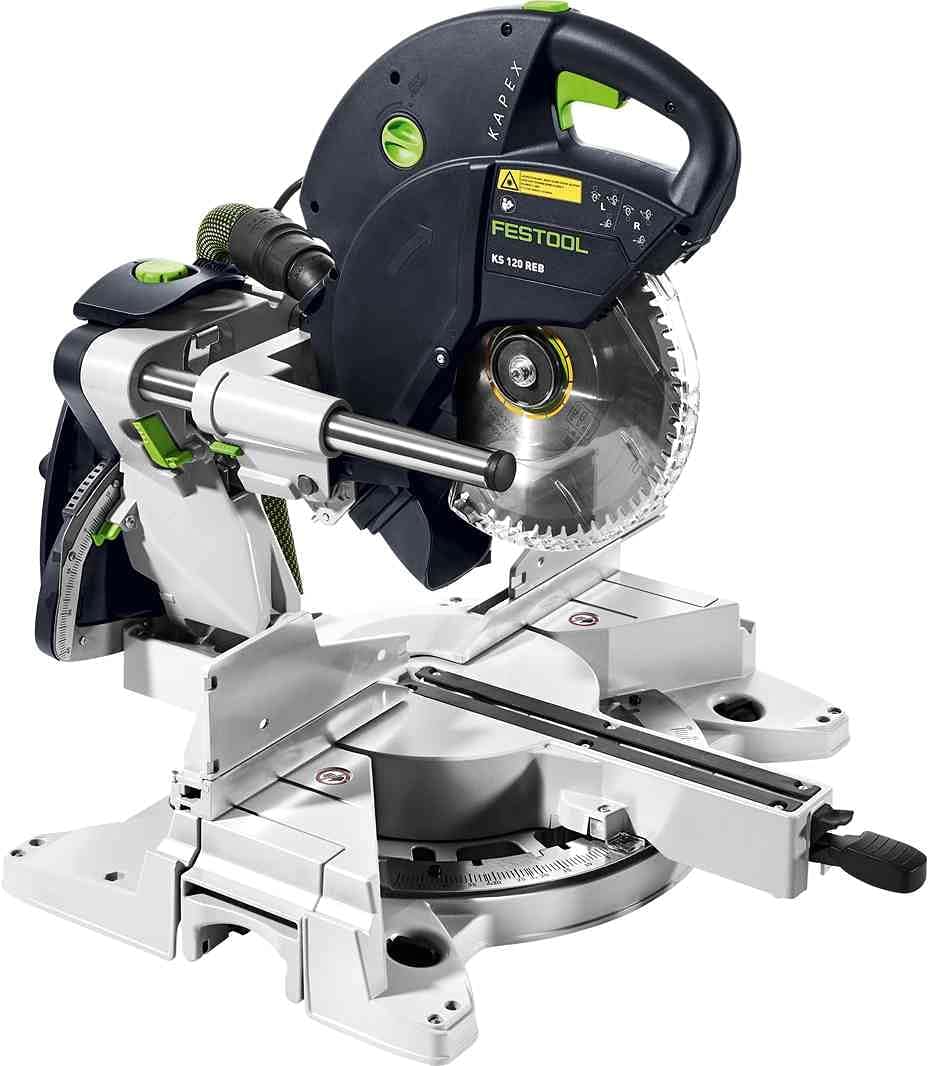
Precision woodworking just found its ultimate weapon. Festool Kapex KS 120 delivers industry-leading dust collection, exceptional cutting accuracy, and premium build quality that rivals nothing else available today. Its 1,600-watt direct-drive motor features a magnetic brake that stops the blade within three seconds, eliminating dangerous spin-down time completely. You benefit from zero blade wobble on every single pass through hardwood. Integral table extensions lock securely, offering additional support for longer stock without requiring separate accessories. Single-handed blade changes save valuable time on busy job sites. A rail-forward design creates a compact footprint, allowing placement flush against walls for all cutting tasks. Dual independent lasers show exactly where each blade side lands before cutting begins. What we love most is how German engineering solves real problems professionals face daily — dust, deflection, and speed. Competitors like Bosch Glide offer 80% of this performance at a more accessible price point. Micro-adjusting miter angles near a detent requires several frustrating attempts without a dedicated adjustment mechanism. Kapex rewards professionals who demand absolute accuracy above everything else — invest confidently here.
2. Makita LS1219L Miter Saw

Serious woodworkers demand serious tools — and Makita delivers exactly that. Makita LS1219L features a unique 2-steel rail sliding system, offering smooth and precise operation with a reduced footprint that allows flush wall operation. You gain complete workspace flexibility without sacrificing any cutting capacity whatsoever. Increased capacity handles up to 8-inch crown molding vertically nested, 6-3/4-inch baseboard vertically, and 15-inch crosscuts at 90 degrees. An innovative direct-drive motor eliminates belts entirely, removing any slipping, breaking, or belt-replacement concerns over time. Electronic speed control maintains consistent blade performance under heavy load conditions. An integrated upper and lower 5-1/2-inch tall fence system offers added rigidity for more precise miter and bevel cuts. What impresses most is dual dust collection ports that capture debris far better than single-port competitors manage. A built-in laser clearly indicates the line-of-cut whether the blade is turning or not. Compared to the DeWalt DWS780, Makita provides a superior miter range reaching 60 degrees both directions. Some users report the pivot mechanism collects sawdust buildup, occasionally binding during extended use. Choose Makita LS1219L when cutting capacity and smooth operation matter most.
3. DEWALT DWS780 Miter Saw

Every serious workshop deserves one dependable powerhouse — this is it. DEWALT DWS780 features a powerful 15-amp motor cutting at 3,800 revolutions per minute, handling everything from framing lumber to intricate trim work. You cut wider boards confidently thanks to a sliding arm extending capacity dramatically beyond fixed-head competitors. XPS cutline system casts a shadow line directly from the blade, showing exactly where it will cut without requiring recalibration after blade changes. Stainless steel miter detent plate features 11 positive stops, making common angle repeats fast and reliable. Dual bevel capability allows both left and right tilting, adding versatility particularly valuable during angled compound cuts. Tall sliding fences support crown moulding and wide trim pieces securely during complex cutting operations. Miter adjustment system earned high praise from testing teams for its easy-to-use handle, override system, and overall ergonomics. What stands out most is consistent accuracy maintained across hundreds of consecutive cuts without drifting. Bosch GCM12SD offers smoother glide motion, but DWS780 wins on accessibility and widespread blade availability. Dust collection suffers from a narrow nozzle design, limiting debris capture without an attached vacuum. Buy DWS780 when reliable precision at a competitive price defines your priorities.
4. Bosch GCM12SD Miter Saw
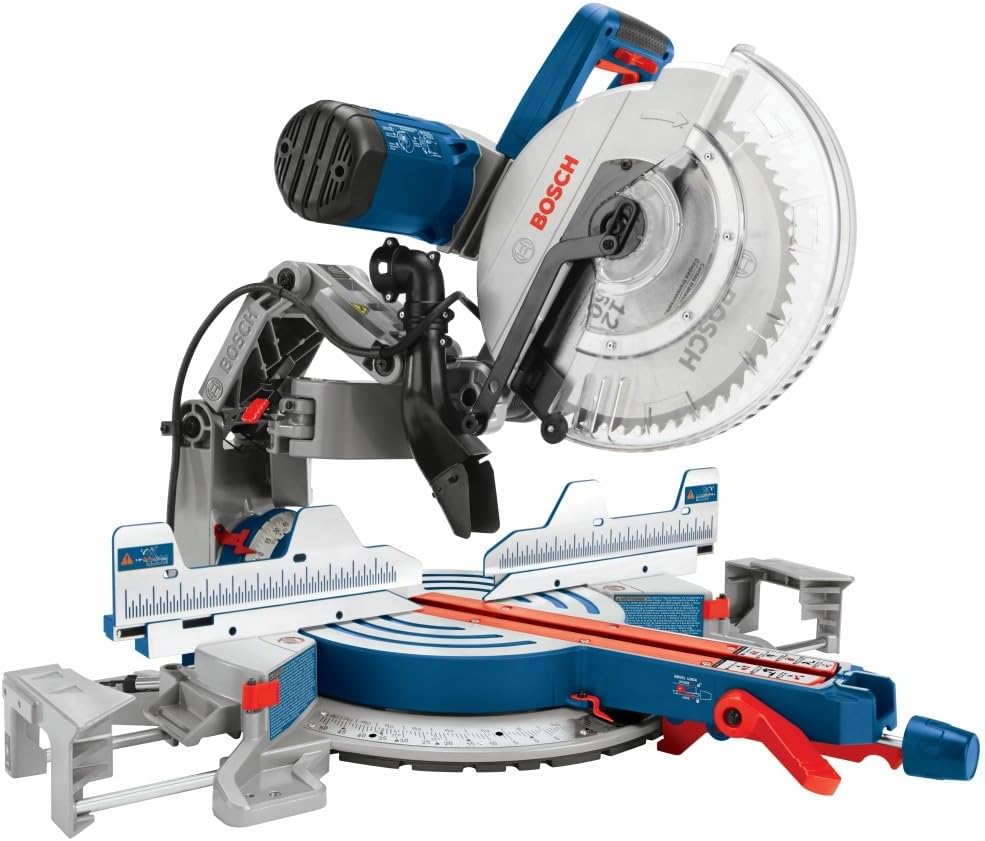
Smooth cutting just reached an entirely new standard. Bosch GCM12SD features an Axial-Glide system delivering smooth motion and space savings without compromising full cutting capacity. You position this saw closer to walls than any traditional sliding model allows, reclaiming valuable workshop real estate. A full 3-horsepower 15-amp motor provides a maximum speed of 3,800 rpm, powering through lumber without hesitation. Miter range spans 52 degrees left and 60 degrees right with 15 detents, while dual bevel tilts 47 degrees both ways with 9 stops. Pre-aligned SquareLock fences maintain precision throughout the saw’s entire working life automatically. A large soft-grip ambidextrous handle keeps users comfortable during all-day operation without causing hand fatigue. Upfront bevel controls eliminate awkward reaching behind the saw during adjustments. What we love most is how the Axial-Glide system feels compared to every competing sliding mechanism — effortlessly superior. Compared to DeWalt DWS780, Bosch achieves tighter 0.1-degree miter accuracy during precision work. Absent LED lighting and limited dust collection performance trail both DeWalt DWS780 and Makita LS1219L noticeably. Invest in GCM12SD when workspace efficiency and buttery-smooth operation define your perfect saw.
5. SKIL MS6305 Miter Saw
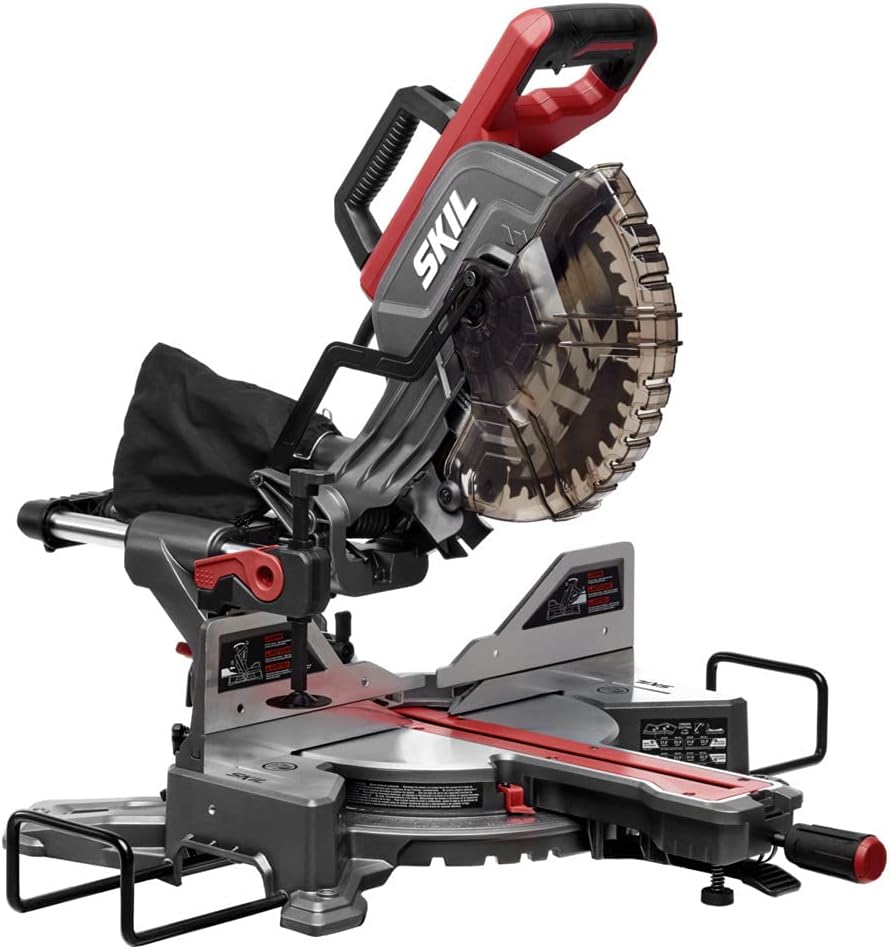
Budget-friendly doesn’t mean cutting corners — this SKIL proves it perfectly. SKIL MS6305-00 is powered by a 15-amp motor spinning its blade at 4,800 RPM, ripping through every species of wood without slowing down. You complete 2×12 crosscuts and 2×8 miter cuts with remarkable ease at this price point. Dual-beveling and mitering to 51 degrees in both directions deliver professional-grade versatility surprisingly unavailable on competing budget models. LED shadow line technology casts a crisp blade shadow onto workpieces, showing exactly where each cut lands even in bright conditions. An onboard blade wrench stores securely on the base, eliminating frantic searching during mid-project blade changes. Dual bevel capability allows cuts up to 48 degrees left and 45 degrees right, complemented by 11 positive stops at commonly used angles. Sliding fences support nested crown cuts up to 6.5 inches without additional accessories. What genuinely surprises most is how confidently this saw handles demanding hardwood cuts. Bosch GCM12SD and DeWalt DWS780 both outperform MS6305 on precision finish work, but cost significantly more. Dust collection performs below average, requiring an external vacuum for cleaner workshop conditions. Choose MS6305 when maximum power at minimum cost defines your buying decision.
Cut With Confidence: The Ultimate Buying Guide to the Best Miter Saws
Introduction
Every woodworker, contractor, and serious DIY enthusiast eventually reaches the same conclusion — a miter saw is one of the most transformative tools you can add to your workshop. No other single power tool delivers the combination of speed, precision, and versatility that a miter saw brings to crosscutting, angle cutting, and compound cutting across wood, trim, moulding, and a wide range of other materials. Once you have worked with a quality miter saw, returning to hand saws or circular saws for these tasks feels like a significant step backward.
The fundamental appeal of a miter saw is precision at speed. Framing a room, fitting skirting boards and architrave, building furniture, constructing decking, installing crown moulding, or simply cutting timber accurately to length — all of these tasks become faster, cleaner, and more consistent the moment a miter saw enters the workflow. The ability to set an exact angle and repeat that cut dozens or hundreds of times with identical results is something that no hand tool can match and that even experienced users find difficult to replicate with a circular saw and guide rail.
For contractors and tradespeople, a miter saw is a job site essential rather than a workshop luxury. Carpenters, joiners, flooring installers, deck builders, and finish carpenters all depend on a reliable miter saw for a significant proportion of their daily cutting work. A quality saw that cuts accurately, durably, and without hesitation is directly connected to the quality of the finished work and the professional reputation that comes with it. A poor saw — one that drifts from its set angle, vibrates excessively, or develops fence and bevel adjustment problems — compromises every joint and every cut it produces.
For home workshop users and dedicated DIY enthusiasts, a miter saw opens up projects that would otherwise be beyond practical reach. Picture frames with precisely mitred corners, built-in shelving with perfectly square end cuts, garden structures with clean compound angles, and timber furniture with tight, gapless joints all become achievable with the right saw and a basic understanding of how to use it. The learning curve for a miter saw is also surprisingly shallow — the fundamental operation of lining up a cut, confirming the angle setting, and bringing the blade down cleanly is something most users master within a single session.
Safety is another compelling reason to choose a miter saw over alternative cutting methods for crosscutting work. The workpiece is held firmly against the fence and table, the cut is controlled by a downward motion with the operator’s hands clear of the blade path, and quality saws include blade guards, electric brakes, and spindle locks that make safe operation straightforward. Compared to freehanding a circular saw or pushing stock through a table saw for crosscuts, a miter saw is genuinely one of the safer power tools in the workshop when used correctly.
The miter saw market has expanded significantly in recent years, with cordless models now matching corded equivalents in cutting performance, double-bevel saws eliminating the need to flip workpieces for compound cuts, and sliding rail systems dramatically increasing the maximum board width a single saw can handle. Knowing which features genuinely serve your work and which are unnecessary complexity for your use case is the key to making a purchase you will still be satisfied with years down the line. This guide gives you the complete picture.
Types of Miter Saws
Miter saws divide into several distinct categories based on their cutting capability, rail system, and power source. Understanding the differences between types helps you match the right saw to the actual demands of your work rather than over-buying capability you will never use or under-buying and discovering limitations at a critical moment.
Type 1: Basic Miter Saws (Single Bevel, Non-Sliding)
The most straightforward miter saw design, a basic single-bevel non-sliding saw cuts miter angles — rotating the blade left and right across a horizontal plane — and tilts the blade in a single direction for bevel cuts. The cutting capacity is fixed by the blade diameter, typically allowing crosscuts up to around 85–100mm in depth and 200–250mm in width depending on the model and blade size. These saws are the lightest, most compact, and most portable in the miter saw category, making them well-suited to job site use where the saw is transported regularly between locations. They are a solid choice for framing carpenters, decking installers, and anyone whose work is primarily straightforward crosscuts and simple miter cuts on standard-dimension timber without regular compound angle requirements.
Type 2: Compound Miter Saws (Single Bevel)
Single-bevel compound miter saws add the ability to tilt the blade head in one direction — typically to the left — while simultaneously holding a miter angle, allowing true compound cuts that combine both miter and bevel angles in a single pass. This compound cutting capability is essential for crown moulding installation, where the workpiece must be cut at a specific combination of miter and bevel angles to fit correctly at the junction of wall and ceiling. Single-bevel compound saws require the user to flip the workpiece for compound cuts that need a right-hand bevel, which adds a step to the workflow but keeps the saw’s mechanical design simpler and the price lower than double-bevel alternatives. They are a versatile all-round choice for finish carpenters, joiners, and home workshop users who need compound cutting capability without the full cost of a double-bevel design.
Type 3: Double Bevel Compound Miter Saws
Double-bevel compound miter saws tilt the blade head in both directions — left and right — without requiring the workpiece to be repositioned or flipped. This significantly speeds up workflows involving repeated compound cuts at opposing angles, such as fitting crown moulding around a complete room where left-hand and right-hand corner cuts alternate continuously. The elimination of workpiece flipping also reduces the risk of measurement and setup errors that can occur when repositioning. Double-bevel saws are preferred by professional finish carpenters and joiners who work with crown moulding, angled trim, and compound joinery regularly, and by any user whose workflow involves frequent alternating compound cuts where speed and consistency are priorities.
Type 4: Sliding Compound Miter Saws
Sliding compound miter saws add a set of horizontal rails that allow the blade and motor head to travel forward and backward through the cut in addition to the standard downward plunge motion. This sliding action dramatically increases the maximum crosscut width the saw can handle — from the fixed 200–250mm of a non-sliding saw to 300–350mm or beyond depending on the model — making it possible to crosscut wide boards, large sheet material sections, and wide decking planks that a non-sliding saw simply cannot accommodate. Sliding saws are larger, heavier, and require more clearance behind the saw for the rails to extend, which affects workshop layout planning. They are the preferred choice for furniture makers, builders working with wide timber, workshop-based carpenters, and anyone who regularly needs to crosscut material wider than a standard non-sliding saw can manage.
Type 5: Cordless Miter Saws
Cordless miter saws use high-voltage battery platforms — typically 18V, 36V, 54V, or dual-battery configurations — to deliver cutting performance that in recent generations has reached genuine parity with corded equivalents for most real-world cutting tasks. The freedom from a power cord is a significant practical advantage on job sites where power outlets are distant, unavailable, or require extension leads that create trip hazards and voltage drop. Modern cordless miter saws are available in single-bevel, double-bevel, and sliding configurations, covering the full range of cutting capabilities. Battery life is the key practical limitation — heavy continuous use drains batteries that require recharging or swapping, making spare batteries essential for all-day job site use. They are the natural choice for mobile contractors, site carpenters, and anyone who values cordless freedom and already operates within an established battery platform ecosystem.
Key Features to Look For
Blade Size and Cutting Capacity
Blade diameter is the primary determinant of a miter saw’s cutting capacity. The two most common sizes are 216mm (8.5-inch) and 254mm (10-inch) for standard saws, and 305mm (12-inch) for large-capacity models. A larger blade cuts deeper and wider in a single pass, handling larger timber sections without the limitations that force smaller saws to make multiple repositioning cuts. However, larger blades require more powerful motors, add weight to the saw, and produce higher noise levels. For most home workshop users and finish carpenters working with standard timber dimensions, a 216mm or 254mm saw covers the vast majority of cutting requirements. Builders and contractors regularly cutting large-section structural timber or wide boards benefit meaningfully from a 305mm blade’s additional capacity.
Positive Stops and Angle Accuracy
The ability to set and return to common cutting angles quickly and reliably is one of the most practically important features of a miter saw. Quality saws include positive stops — also called detents — at the most frequently used miter angles: 0°, 15°, 22.5°, 30°, and 45° as a minimum. These detents allow the saw to snap into position at these angles without requiring the operator to fine-tune the angle setting from scratch each time, dramatically speeding up repetitive cutting workflows. Equally important is the accuracy of these stops from the factory and their ability to maintain that accuracy over years of use. Look for saws with robust, adjustable detent systems that can be recalibrated if they drift, and test or check owner reviews specifically for the accuracy of the 90° and 45° positions, as these are the two most frequently used settings in most cutting workflows.
Dust Collection Efficiency
Miter saws produce significant volumes of fine sawdust that can quickly contaminate a workshop, create respiratory hazards, and obscure the cut line at critical moments. The quality of a saw’s dust collection system — the design of the blade guard, the routing of the dust port, and the efficiency with which it captures airborne dust at the source — varies dramatically between models. Look for saws with large-diameter dust ports that accept standard vacuum hose fittings, and check owner reviews specifically for real-world dust collection performance rather than relying on manufacturer efficiency claims. Connecting a shop vacuum to the dust port is the most effective dust management approach and is recommended regardless of how efficient the saw’s own collection system appears.
Motor Power and No-Load Speed
Motor power — expressed in watts or amps — determines the saw’s ability to maintain blade speed under load when cutting through dense hardwoods, thick stock, or engineered timber products. A motor that bogs down under load produces rough, inconsistent cuts and accelerates blade wear. For general timber cutting, a 1,400–1,600W motor in a 254mm saw is adequate. For harder species, thicker sections, or more demanding production cutting, 1,800W or above provides comfortable headroom. No-load blade speed — expressed in RPM — affects cut quality: higher RPM generally produces smoother cuts across most materials, though the optimal speed for any specific material also depends on blade tooth count and tooth geometry.
Things to Consider Before Buying
Type of Work and Materials: The most important question to answer before choosing a miter saw is what you will actually be cutting, and how frequently. A site carpenter primarily cutting framing timber to length needs a different tool than a finish joiner fitting crown moulding in luxury homes, who in turn needs a different tool than a furniture maker crosscutting wide hardwood boards. Map your most common cutting tasks to the saw type and capacity that handles them — the right size and type for your work is always a better choice than the largest or most feature-rich saw regardless of what your work actually demands.
Workshop Space and Portability: Miter saws — particularly large sliding models — require meaningful workshop space. A 305mm sliding saw can need 600mm or more of clearance behind the fence for the rails to extend fully, and the table and fence width adds further footprint. Measure your intended installation space carefully before purchasing, and account for the clearance needed for workpiece support on both sides of the saw for long timber pieces. If the saw will be transported regularly to job sites, weight is a critical consideration — large sliding saws can weigh 25–35kg, which is a significant load for regular solo transport.
Corded vs. Cordless: For workshop-based use where a power outlet is always available, a corded saw offers unlimited runtime and consistent power delivery without battery management considerations. For job site use, particularly in locations without reliable power access, a quality cordless saw from an established battery platform removes a genuine practical constraint. If you are already invested in a specific battery platform — Makita, DeWalt, Milwaukee, Festool, or similar — choosing a miter saw from the same platform maximises battery interchangeability and is often the most economically practical choice.
Laser Guides and Cut Line Indicators: Many miter saws include a laser line projector that shines a visible line onto the workpiece indicating exactly where the blade will cut. While laser guides can be useful for new users developing their cut line reading skills, experienced operators typically rely on the blade kerf and fence shadow for cut line alignment and find laser guides an optional rather than essential feature. Shadow line cut indicators — a slot in the blade guard that casts a shadow precisely at the blade’s cutting edge — are preferred by many professionals for their accuracy and zero-maintenance operation compared to lasers that require alignment and battery replacement.
Step-by-Step Buying Guide
1. Research Your Needs
Before evaluating specific products, define your cutting requirements as concretely as possible. What is the maximum width and depth of material you regularly need to cut? Do your projects require compound cuts, or are standard miter and crosscuts sufficient? Will the saw live permanently in a workshop or travel to job sites? Do you have an existing battery platform that a cordless saw should ideally match? Are there space constraints in your workshop that limit the depth or width of saw you can accommodate? These answers narrow the field from dozens of possibilities to a manageable shortlist of tools that genuinely fit your actual work, preventing both over-specification and the frustrating discovery of capability limitations after purchase.
2. Compare Products
With your requirements defined, compare specific models from established tool manufacturers including Makita, DeWalt, Festool, Bosch, Milwaukee, Metabo, and Evolution, evaluating how each model’s documented specifications and independent test results align with your cutting needs. Seek out reviews from woodworking publications, professional trade publications, and independent tool testing channels that include practical cutting tests on materials representative of your own work — not just specification comparisons. Pay particular attention to long-term owner reviews covering fence and bevel adjustment durability, positive stop accuracy over time, dust collection real-world performance, and motor longevity under regular production use, as these are the areas where quality differences between saw tiers become most apparent over a working lifespan.
3. Finalise Your Choice
Before completing your purchase, confirm the manufacturer’s warranty terms — most professional-grade miter saws carry a minimum two to three year warranty, with some brands offering longer coverage for tools registered through their professional programs. Verify that authorised service centres are accessible in your region, as a miter saw requiring calibration or repair needs access to technicians familiar with the specific brand and model. Purchase from authorised tool dealers or established retailers who can support warranty claims and provide genuine replacement parts. Be cautious of heavily discounted tools through unverified channels, particularly for professional-grade models where counterfeit and grey-market units with compromised safety certifications are a known issue.
Maintenance Tips
Keep the blade sharp and appropriate for the material: A dull miter saw blade is the single most common cause of poor cut quality, excessive motor strain, and burning or tear-out on the workpiece surface. Inspect the blade regularly and replace or have it professionally resharpened when cut quality deteriorates, when the motor sounds strained during cuts that should be straightforward, or when burn marks appear on the cut face. Also confirm that the blade installed on the saw is appropriate for the material being cut — a general-purpose wood blade performs poorly on non-ferrous metals, laminates, or plastics, each of which has dedicated blade designs optimised for the specific material’s cutting characteristics.
Clean and lubricate the slide rails and pivot points regularly: On sliding saws, the rails that carry the blade head forward and backward accumulate sawdust and resin that gradually increases friction, produces inconsistent sliding action, and can cause the head to bind or drift during cuts. Clean the rails with a dry cloth after every extended cutting session and apply a light machine oil or dedicated rail lubricant periodically to maintain smooth, consistent travel. Pivot points for the miter and bevel adjustments similarly benefit from periodic cleaning and light lubrication to prevent stiffness and ensure adjustments can be made smoothly and held securely during cutting.
Check and recalibrate angle accuracy periodically: Even quality miter saws can drift from their factory-set angle accuracy over time, particularly after transportation, heavy use, or accidental impacts. Check the accuracy of the 90° crosscut position and the 45° miter position regularly using a reliable engineer’s square and angle gauge, and adjust the positive stop calibration screws — which are accessible on virtually all quality saws — to bring the saw back to accurate settings whenever drift is detected. Making this check part of a regular maintenance routine, rather than waiting until a cut comes out wrong, prevents the frustration and material waste of discovering calibration drift mid-project.
Common Issues and Troubleshooting
Cuts are not square — workpiece shows an angle when crosscutting at 0°: First confirm that the fence is clean, flat, and free of sawdust build-up that could be holding the workpiece away from the fence face at an angle. Then check the blade’s perpendicularity to the table using a reliable square — the blade should be exactly 90° to the table at the 0° bevel setting. If it is not, adjust the bevel stop calibration screw. Also verify that the blade itself is not warped or damaged, as a bent blade produces cuts that appear to come from a misaligned saw even when the saw’s settings are correct.
Excessive tear-out on the top face of the workpiece: Tear-out on the top surface of a cut typically indicates a blade with too few teeth for the material being cut, a dull blade, or an excessively fast feed rate through the material. For clean cuts on hardwood, veneered panels, and finished timber, use a high tooth-count blade — 60 to 80 teeth on a 254mm blade — and allow the blade to reach full speed before beginning the cut. A zero-clearance insert around the blade opening, where the table surface supports the material fibres right to the edge of the cut, also significantly reduces tear-out.
Saw vibrates excessively during operation: Excessive vibration most commonly originates from a blade that is not correctly seated on the arbor, a damaged or unbalanced blade, or a worn spindle bearing. Check that the blade is mounted correctly and the arbor nut is tightened to the manufacturer’s specified torque. If the blade appears undamaged and correctly mounted, try a known-good replacement blade to determine whether the issue is blade-specific. Persistent vibration with multiple blades points to worn spindle bearings that require professional service.
Positive stops feel loose or the saw will not hold a set angle during cutting: Loose positive stops that allow the saw to shift during a cut are a safety and accuracy concern that should be addressed immediately. Most miter saws include accessible adjustment screws for each detent position — consult the saw’s manual for the specific adjustment procedure. If the detent mechanism itself is worn or damaged rather than simply misadjusted, the assembly may require replacement. In the interim, use the saw’s angle lock mechanism to firmly secure the angle setting before every cut rather than relying on the detent alone.
Final Words
Choosing the right miter saw is an investment in the quality, consistency, and efficiency of every cutting task you undertake — and it is a decision that will shape your work for many years. The right saw for your needs makes accurate cuts feel effortless, handles your most common materials without strain, fits your workspace comfortably, and remains reliable through thousands of cuts without losing the calibration accuracy that precise joinery depends on.
Match the saw type and capacity to the work you actually do — not the work you imagine you might do one day. A well-chosen mid-range saw that perfectly suits your real cutting demands will outperform a larger, more complex saw that is more tool than your workflow requires. Prioritise angle accuracy, build quality, and blade capacity over feature lists, and give appropriate weight to long-term reliability feedback from users who have put the saw through real production use rather than casual occasional cutting.
Take your time, do your research, and choose with confidence. The right miter saw will repay every hour of careful selection with years of precise, satisfying cuts — and every project you complete with it will reflect the quality of the tool you chose to trust with your work.