
“Your car’s outdated stereo is ruining every road trip with crackling audio and dropped calls. Today, we test the best Bluetooth FM transmitters that instantly transform any old stereo into a modern entertainment system. No expensive installations, no complicated wiring, just pure crystal-clear sound from your very first drive.” I dropped the updated link in the description.
Top 5 Bluetooth FM Transmitters for Cars:
1. Nulaxy KM18 Bluetooth 5.4 Car Adapter

Smart and reliable, the Nulaxy KM18 upgrades your car audio experience instantly. You quickly notice how this Nulaxy KM18 feels more refined than many basic FM transmitters. Setup takes minutes, and pairing stays fast thanks to Bluetooth V5.4 stability.
Sound quality stands out with noise cancellation, delivering clearer calls and cleaner music than cheaper adapters. A 1.44-inch LCD display shows useful details like calls, voltage, and tracks without distracting your driving focus. Flexible gooseneck design lets you adjust viewing angles easily, improving comfort during long trips.
Hands-free calls work smoothly using a single control button, helping you stay focused on the road. Music streaming performs consistently across Bluetooth, TF card, and Aux connections for flexible listening options. Wide compatibility ensures it works with most smartphones, tablets, and older audio devices without issues.
Connection remains stable even in busy signal areas, which many competing transmitters struggle to handle. Display size may feel small when checking detailed information quickly while driving. Overall, you get a feature-rich car adapter that balances sound quality, usability, and connectivity very well.
2. Syncwire Bluetooth 5.4 FM Transmitter for Car

Clean, fast, and reliable, the Syncwire Bluetooth 5.4 FM Transmitter upgrades your drive instantly. You feel the difference as this Syncwire Bluetooth 5.4 FM Transmitter connects quicker than older adapters. Pairing stays smooth, and connection strength remains steady during long trips.
Charging speed stands out with PD 3.0 and QC 3.0 support, powering devices much faster than standard options. Dual charging ports add convenience, letting you charge two gadgets without slowing performance. Bluetooth 5.4 improves stability, reducing lag and dropouts compared with previous versions.
Audio quality feels rich with Hi-Fi deep bass, adding depth that many transmitters fail to deliver. Backlit lighting creates a subtle glow, helping you locate controls easily in low light. Noise suppression improves call clarity, making conversations sound clean even in busy traffic.
Hands-free controls work smoothly, allowing quick call handling without distraction. Wide compatibility ensures easy pairing with most phones and tablets across different platforms. Knob control may take slight adjustment during first use for precise volume changes. Overall, you get a balanced transmitter that combines strong audio, fast charging, and dependable connectivity in daily use.
3. UNBREAKable Bluetooth 5.3 FM Transmitter for Car

Fast, powerful, and feature-packed, the UNBREAKcable Bluetooth 5.3 FM Transmitter elevates in-car audio instantly. You notice right away how this UNBREAKcable Bluetooth 5.3 FM Transmitter feels more advanced than basic adapters. Setup runs quickly, and pairing stays stable during daily driving.
Charging performance stands out with PD 20W and QC 3.0 support, powering devices much faster than standard ports. Built-in safety protections add confidence, keeping charging secure under different conditions. Bluetooth 5.3 ensures steady connections, reducing dropouts common with older transmitters.
Audio quality feels richer thanks to HiFi bass boost, delivering deeper sound compared with typical FM options. Anti-statics design helps remove unwanted noise, improving clarity during music playback and calls. Voice navigation support lets you hear directions clearly without touching your phone.
Joystick control simplifies operation, making adjustments easier than traditional rotary dials. Hands-free calling works smoothly, allowing safe communication while driving. Wide compatibility ensures it connects easily with many devices and vehicle types.
Blue backlit lighting may feel slightly bright during night driving conditions. Overall, you get a reliable, high-performance transmitter that balances sound, charging speed, and usability effectively.
4. LENCENT FM Transmitter, Bluetooth FM Transmitter
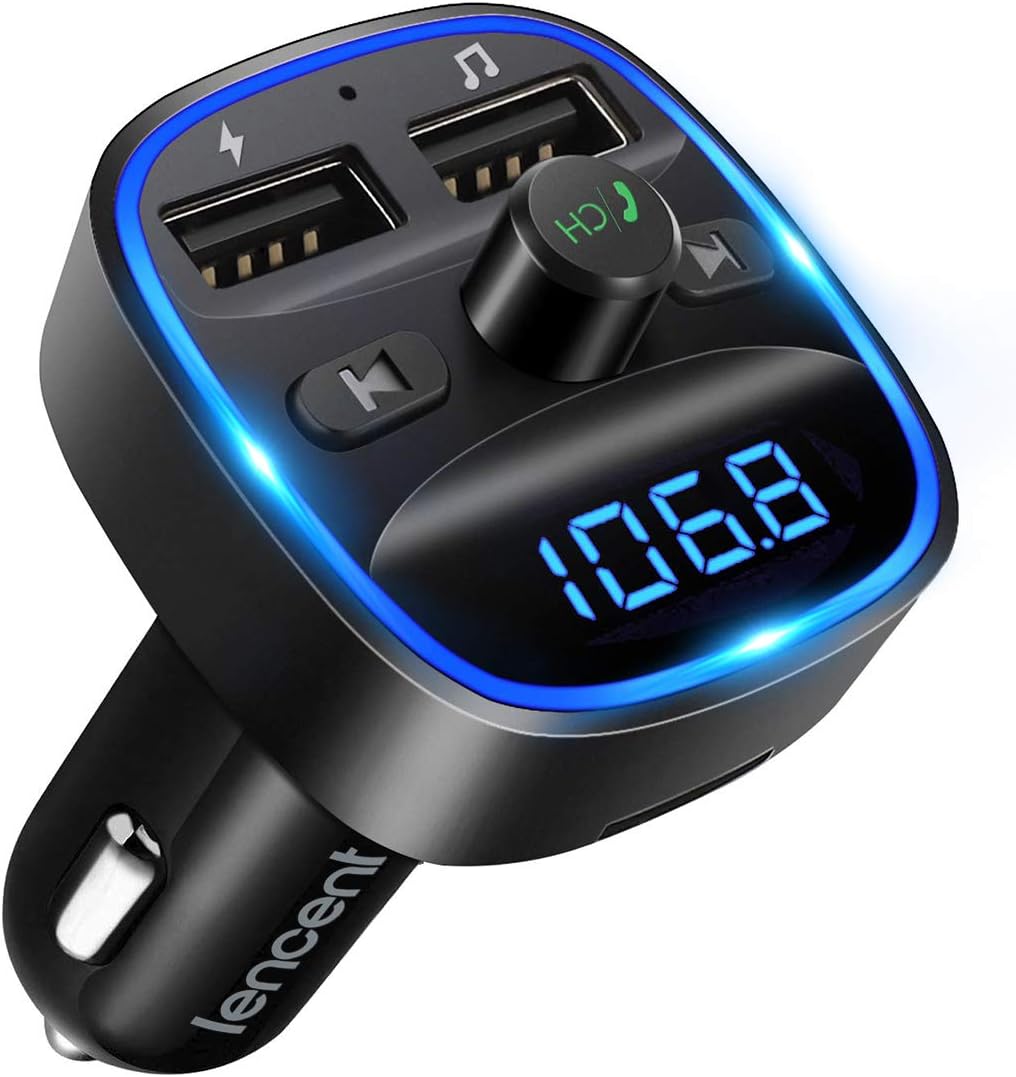
Simple, dependable, and practical, the LENCENT FM Transmitter improves everyday driving audio quickly. You notice how this LENCENT FM Transmitter competes well with pricier adapters in real use. Setup feels quick, and pairing reconnects automatically after initial connection.
Audio performance stays clear thanks to CVC noise suppression, reducing wind and background interference effectively. Multiple playback options let you stream via Bluetooth, USB flash drive, or microSD card for added flexibility. Format support handles common audio files smoothly, avoiding compatibility issues found in cheaper units.
Dual USB ports allow charging two devices at once, making long drives more convenient for passengers. Built-in safety protections help maintain stable charging without overheating or power issues. Hands-free calling works clearly, while voice navigation plays directions without distortion.
Voltage detection stands out, letting you monitor your car battery and avoid unexpected problems. Blue ambient lighting improves visibility, helping locate controls easily at night. Charging speed feels slower compared with newer fast-charging transmitters on the market. Overall, you get a reliable adapter that balances sound quality, safety features, and everyday usability effectively.
5. Nulaxy 54W Bluetooth 5.3 Car Adapter

Power meets versatility with the Nulaxy 54W Bluetooth 5.3 Car FM Transmitter. You quickly notice how this Nulaxy 54W Bluetooth 5.3 Car FM Transmitter outperforms basic adapters in daily driving. Setup feels smooth, and pairing connects fast with strong stability.
Charging performance stands out with 54W output, supporting four devices without slowing speed. PD36W and QC3.0 ports deliver fast power, reducing wait time compared with standard chargers. Bluetooth 5.3 improves connection quality, keeping audio steady and reducing signal drops.
Sound quality feels richer with deep bass enhancement, adding more depth than typical transmitters. Five-colour LED lighting helps visibility at night, making controls easier to locate quickly. Voice command support allows navigation audio, and assistant control without touching your phone.
Touch control design feels precise, letting you adjust settings easily without distraction. Wide compatibility ensures smooth use across different vehicles and devices. Safety protections add confidence, keeping charging stable during long drives.
Large size may feel slightly bulky in tighter cigarette lighter spaces. Overall, you get a powerful, feature-packed transmitter that combines fast charging, strong audio, and reliable connectivity effectively.
Tune In and Drive On: The Ultimate Buying Guide to the Best Bluetooth FM Transmitter for Car
Introduction
There is nothing quite like the feeling of hitting the open road with your favourite music playing at full volume, a podcast keeping you company on a long commute, or a hands-free call that lets you stay connected without taking your eyes off the road. For millions of drivers, a Bluetooth FM transmitter makes all of this possible — even in vehicles that were manufactured long before wireless audio and smartphone integration became standard features.
The reality is that a significant number of cars on the road today still lack Bluetooth connectivity, aux input ports, or any form of modern audio integration. Replacing the entire head unit to gain these features can be expensive, invasive, and sometimes not even possible depending on the vehicle. A Bluetooth FM transmitter solves this problem elegantly — it plugs into your car’s cigarette lighter or USB port, broadcasts audio over an FM frequency, and lets your car radio pick it up just like any other station. The result is wireless music streaming, hands-free calling, and smartphone audio through your existing speakers with no permanent modifications required.
Beyond music, these compact devices have quietly become essential tools for road safety. Hands-free calling laws are now enforced in most countries and states, and a good Bluetooth FM transmitter gives you a fully legal, voice-activated way to make and receive calls while keeping both hands on the wheel. Some models even support voice assistants like Siri and Google Assistant, bringing the full power of your smartphone to your dashboard without a dedicated smart display.
Modern FM transmitters have come a long way from the noisy, signal-dropping devices of the early 2000s. Today’s models feature clear digital Bluetooth transmission, multiple USB charging ports to keep your devices powered during long drives, LED displays for easy frequency management, noise cancellation microphones for cleaner call quality, and even quick charge technology to rapidly top up your phone while you drive. Some high-end models include built-in EQ settings, car voltage monitoring, and dedicated app controls that let you manage everything from your phone.
The versatility of FM transmitters extends beyond personal use too. Families use them to stream children’s audiobooks and playlists during road trips. Rideshare drivers use them to create a better in-car experience for passengers. Delivery professionals rely on them for navigation audio and hands-free communication during long shifts. Wherever there is a car without modern connectivity and a driver who wants the convenience of wireless audio, a Bluetooth FM transmitter fills that gap perfectly.
Yet despite their apparent simplicity, not all FM transmitters are created equal. Audio quality, transmission range, Bluetooth version, charging speed, display visibility, and build quality vary enormously between models, and a poor choice can result in a frustrating experience of static, signal interference, dropped connections, and devices that barely last a year. This guide is designed to help you navigate the options with confidence and find the transmitter that genuinely fits your driving life.
Types of Bluetooth FM Transmitters for Cars
FM transmitters come in several distinct designs, each suited to different vehicles, usage habits, and dashboard setups. Knowing which type works best in your car is the foundation of a good purchase decision.
Type 1: Cigarette Lighter / 12V Socket FM Transmitters
These are the most common and widely used type of FM transmitter. They plug directly into your car’s 12V cigarette lighter socket and draw power from it continuously while the engine is running. Most models in this category include one or two USB charging ports on the device itself, making them a dual-purpose solution for audio and device charging. They are ideal for the vast majority of drivers because nearly every car has a 12V socket, the setup takes seconds, and they are easy to remove and transfer between vehicles. The protruding design means they can sometimes interfere with the gear stick or console area in tightly configured interiors, so checking the position of your socket before buying is worthwhile.
Type 2: Dual-Socket and Multi-Port FM Transmitters
An evolution of the standard cigarette lighter type, multi-port transmitters feature several USB ports — often including a combination of standard USB-A, USB-C, and fast-charging ports — in a single unit. They are specifically designed for drivers who need to charge multiple devices simultaneously, such as a smartphone, tablet, and dash cam, without occupying additional power sockets. Families, rideshare drivers, and anyone who regularly carries passengers with charging needs will find these models particularly practical. The larger body size of multi-port units means fit and positioning in the console area deserves extra consideration before purchasing.
Type 3: Low-Profile and Flush-Fit FM Transmitters
Designed for drivers who prefer a cleaner, more integrated look in their vehicle, low-profile FM transmitters sit nearly flush with the 12V socket rather than protruding significantly into the cabin. They are a strong choice for vehicles where the socket is positioned in a central console or tight space where a standard protruding transmitter would be obstructive or visually cluttered. Some flush-fit models rely on a companion smartphone app for frequency control and settings rather than a built-in display. They suit minimalist drivers and those with higher-end vehicle interiors where aesthetics matter as much as function.
Type 4: USB-Powered Dashboard FM Transmitters
Rather than using the 12V cigarette lighter socket, some FM transmitters are designed to connect via a vehicle’s built-in USB port or an external USB adapter. These are typically smaller and lighter than socket-based models and are a good fit for newer vehicles that have USB ports readily accessible. They do require a USB port that provides sufficient power output, so compatibility should be confirmed before purchase. These models work well for drivers of newer vehicles who want a compact, low-profile audio solution without occupying the cigarette lighter socket at all.
Key Features to Look For
Bluetooth Version and Audio Quality
The Bluetooth version of an FM transmitter directly affects the stability of the wireless connection, audio transmission quality, and range. Bluetooth 5.0 and above offer significantly more stable connections, lower latency, and better overall audio clarity compared to older versions. A transmitter running an outdated Bluetooth version will be more prone to dropouts, audio lag during video playback, and interference from other wireless devices. Always check the Bluetooth version before buying — it is one of the most reliable indicators of day-to-day audio performance.
FM Frequency Range and Interference Resistance
The FM transmitter works by broadcasting your audio on a specific FM frequency that your car radio then tunes into. The quality of this transmission, and how resistant it is to interference from local radio stations using nearby frequencies, is critical to audio clarity. Look for transmitters that offer a wide FM frequency range — ideally 87.5MHz to 108.0MHz — so you can always find a clear, unused frequency in your area. Some advanced models include an automatic frequency scanning feature that finds and locks onto the clearest available channel without manual searching, which is a particularly useful feature for drivers who travel between regions with different local radio landscapes.
Charging Capability and Port Options
Since the FM transmitter already occupies your 12V socket, it should earn its place by also solving your in-car charging needs. Look for models that include at least one high-output USB port, and prioritise models with Quick Charge or USB Power Delivery support if you use a modern smartphone. Dual charging ports are especially useful for passengers. A transmitter that charges your phone slowly or not at all represents a missed opportunity given that it is already connected to your vehicle’s power supply at all times.
Display, Controls, and Ease of Operation
A clear, well-positioned LED or LCD display makes a meaningful difference to usability while driving. You should be able to read the current FM frequency at a glance without needing to squint or lean toward the console. Physical buttons that can be operated by feel — rather than a touchscreen that requires visual confirmation — are significantly safer and more convenient while driving. Some premium models include a separate wired or magnetic button pad that mounts on the steering column or dashboard, allowing full control without taking your hand off the wheel. App-based control is a convenient supplement but should not be the only way to operate the device.
Things to Consider Before Buying
Compatibility with Your Vehicle: Before anything else, confirm that your car has a functioning 12V cigarette lighter socket or suitable USB port in an accessible, practical location. Check where the socket is positioned in your specific model — some vehicles place theirs in the centre console, armrest, or glove compartment, which may make a protruding FM transmitter awkward or obstructive. Also consider whether your car radio can manually tune to specific FM frequencies, as most can, but some newer integrated infotainment systems have limited FM tuning that could restrict your ability to find a clear channel.
Size and Fit in Your Console: FM transmitters range from compact flush-fit models to larger multi-port units with prominent displays. In a smaller car with a tight centre console, a bulky transmitter may obstruct the gear stick or restrict access to other controls. In a larger vehicle or SUV with a more open console layout, a bigger unit with multiple ports and a clear display is perfectly practical. Visualise how the device will sit in your specific vehicle before committing to a particular form factor, and check product dimensions against your available console space.
Ease of Use While Driving: An FM transmitter should make driving safer and more convenient, not add complexity or distraction. Prioritise models with clear physical buttons, readable displays, and simple pairing processes. Avoid models where essential functions like answering a call or changing a track require navigating a companion app while driving. The best transmitters are intuitive enough to operate largely by feel after a day or two of use, meaning you rarely need to look away from the road to control them.
Build Quality and Durability: FM transmitters live in an environment that is harder on electronics than most people realise. In-car temperatures can swing from well below freezing in winter to extremely high temperatures inside a parked car in summer. Vibration, dust, and constant connection and disconnection cycles add further wear. Look for transmitters built from quality materials with solid socket connections that do not wobble or feel loose. Metal housing, reinforced connectors, and quality USB port construction are all signs of a device built to last through years of daily use rather than one likely to fail within months.
Step-by-Step Buying Guide
1. Research Your Needs
Before comparing specific products, take a few minutes to define exactly what you need from an FM transmitter. Do you primarily want music streaming, hands-free calling, or both? How many devices do you typically need to charge simultaneously? Do you value a clean, low-profile look or does a larger display and more ports matter more? Is your vehicle interior tight around the console, or is there ample space for a standard-sized unit? Answering these questions honestly will immediately narrow a crowded market down to the products that will genuinely serve your driving life well.
2. Compare Products
With your priorities defined, compare at least four to five specific models using independent technology review sites, automotive accessories blogs, and verified buyer reviews on major retail platforms. Focus particularly on reviews that mention long-term use — sound quality, connection stability, and build durability after six months or more of daily use tell a far more useful story than first-impression reviews. Check that the Bluetooth version matches your requirements, confirm that the FM frequency range covers your local broadcast environment, and look for any recurring complaints about static, charging speed, or button reliability that suggest a systemic product flaw rather than isolated user error.
3. Finalise Your Choice
Once you have settled on one or two strong candidates, verify the warranty terms before completing your purchase. Most reputable FM transmitter brands offer at least a twelve-month warranty, and some extend coverage to eighteen or twenty-four months as a confidence signal about their build quality. Purchase from authorised retailers or established online marketplaces with clear buyer protection and returns policies. Avoid purchasing from unknown third-party sellers offering heavily discounted prices on well-known brands, as the FM transmitter market has a notable presence of counterfeit products that perform poorly and fail quickly.
Maintenance Tips
Keep the connection port clean: The 12V socket in many vehicles accumulates dust, debris, and oxidation over time, which degrades the quality of the electrical connection between the socket and the transmitter. Every few months, use a small amount of electrical contact cleaner on a cotton swab to clean inside the socket. A clean, firm connection prevents intermittent power issues and audio interference that many drivers mistakenly attribute to the transmitter itself rather than the socket it plugs into.
Avoid leaving it in direct sunlight during long parked periods: Prolonged exposure to intense direct sunlight significantly accelerates the degradation of plastic housings, display screens, and internal components. When parking for extended periods in hot weather, remove the transmitter from the socket or store it in the glove compartment. This simple habit meaningfully extends the lifespan of the device and prevents the display fading and plastic brittleness that shortens the life of many in-car electronics unnecessarily.
Reset the Bluetooth pairing periodically: Over time, a growing list of saved devices in the transmitter’s memory can cause slower pairing times and occasional connection instability. Every few months, clear the paired device list and re-pair your primary phone from scratch. This takes less than two minutes and keeps the Bluetooth connection fast, clean, and reliable. If you notice audio stuttering or pairing delays that were not present when the device was new, a fresh pairing reset is almost always the first and most effective fix.
Common Issues and Troubleshooting
Audio sounds static-heavy or unclear: The most common cause is frequency interference from a nearby radio station broadcasting on or near your chosen FM channel. Try scanning for a clearer, unused frequency — particularly one at the lower or higher end of the FM range, which tends to be less crowded in most areas. If static persists across multiple frequencies, check that the transmitter is firmly seated in the socket and that the socket itself is clean and making solid contact.
Bluetooth keeps disconnecting during drives: Bluetooth instability is often caused by the phone being at the edge of the transmitter’s effective range, other nearby Bluetooth devices competing for connection, or an outdated phone operating system. Ensure your phone’s software is fully updated, clear the transmitter’s paired devices list and re-pair from scratch, and check that no other Bluetooth devices are actively trying to connect to your phone simultaneously during drives.
Phone is not charging or charging very slowly: Confirm that the USB port you are using matches the charging standard your phone requires. A phone that supports fast charging will charge at standard speeds if connected to a port that does not support the same fast-charge protocol. Also check that the total power draw across all connected devices does not exceed the transmitter’s output capacity, as overloaded multi-port units will throttle charging speeds across all connected devices simultaneously.
Callers report difficulty hearing you during calls: Microphone performance degrades significantly when the transmitter is positioned far from the driver. Try repositioning the device to a socket closer to the driver’s seat if multiple sockets are available. Also check whether any noise cancellation settings in the companion app have been accidentally disabled, and reduce road noise by keeping windows closed during calls when audio quality is critical.
Final Words
A Bluetooth FM transmitter is one of the simplest, most effective upgrades you can make to your driving experience — transforming an older vehicle into a modern, connected, hands-free environment without a single permanent modification. The right transmitter will make every drive more enjoyable, safer, and more convenient, whether you are commuting across the city, travelling across the country, or simply running everyday errands.
Focus on what genuinely matters for your situation: Bluetooth version and audio clarity if sound quality is your priority, charging ports and fast-charge support if keeping devices powered is essential, compact design if your console space is limited, and display readability if you frequently switch frequencies or need at-a-glance information while driving. A well-chosen FM transmitter does its job so seamlessly that you stop thinking about it entirely — it simply becomes a natural part of every drive. Take your time, read real user experiences, and invest in a device built to last. Your daily commute will thank you for it.